
Tags
Financial Systemic Issues: Booms and Busts - Central Banking and Money - Corporate Governance - Cryptocurrencies - Government and Bureaucracy - Inflation - Long-term Economics - Risk and Uncertainty - Retirement Finance
Financial Markets: Banking - Banking Politics - Housing Finance - Municipal Finance - Sovereign Debt - Student Loans
Categories
Blogs - Books - Op-eds - Letters to the editor - Policy papers and research - Testimony to Congress - Podcasts - Event videos - Media quotes - Poetry
Interview: Alex Pollock on the Fed and Gold | Part I
Published by The Institutional Risk Analyst.
October 3, 2025 | In this special edition of The Institutional Risk Analyst, we feature a discussion with Alex Pollock, Senior Fellow at the Mises Institute. Alex provides thought and policy leadership on financial issues and the study of financial systems. He was president and CEO of the Federal Home Loan Bank of Chicago from 1991 to 2004. We spoke with Alex from his home in Lake Forest, Illinois.
The IRA: Alex, thank you for taking the time to speak with us today. We were at the Lotus Club yesterday talking about Inflated: Money, Debt and the American Dream. One of our former colleagues from Bear, Stearns attended.
Pollock: Know something you and I have in common?
The IRA: Tell us.
Pollock: You worked for Bear Stearns. I worked for Continental Illinois. Two firms that are no longer with us. Educational experiences.
The IRA: We were looking at the FINRA record while doing CE. It now lists JPMorgan as our first employer instead of Bear, Stearns. Well, so technically we worked for Jamie Dimon once upon a time. Thank you for sending over your latest testimony on the Federal Reserve, “How Congress Should Oversee the Federal Reserve’s Mandates.” It provides an interesting counterpoint to the essay by Treasury Secretary Scott Bessent in The International Economy about reforming the Fed. We don’t think that anything will happen on reforming the central bank before the Republic has another financial crisis, but there you are. We are very happy to be living in Westchester County, though, instead of New York City. Leaving Gotham in 2021 was a good move and cut our living expenses by more than half.
Pollock: I feel the same about Lake County, Illinois.
The IRA: Despite the political and fiscal troubles in Chicago, we see that the developers are all scurrying back into greater Chicago. This despite the carnage for the banks. Developers must do development or they'll be out of business. Somebody just took Bank OZK (OZK) out of their misery in Lincoln Yards. But we digress. Let’s spend a little bit of time talking about the Fed and then we can switch gears and talk about gold if that works for you. Or maybe we’ll just talk about gold.
Pollock: Two highly related topics.
The IRA: What questions and comments did you get from the Financial Services Committee members when you were up on the hill talking about the Fed? Do you think any of them understood some of the points you made in your excellent testimony?
Pollock: The testimony was to a task force of the Financial Services Committee. We got some very good questions, including questions on what is the chief thing the Fed is supposed to do. I like the idea that the guiding fundamental principle should be that the first responsibility of the central bank is to provide a sound currency. I recommended that the Financial Services Committee in the House and the Banking Committee in the Senate should both have subcommittees devoted solely to the Fed. The monetary system is so overwhelmingly important that that would make a lot of sense. And then you would get a focus and a buildup of expertise over time. Members of Congress, if they serve on a committee long enough, become quite knowledgeable. Incidentally, the hearing last month was held in the Wright Patman room...
The IRA: Oh, of course. Rep Wright Patman (D-TX) was a long-serving and populist politician from Texas. Known as a "fiscal watchdog," he served in the House for 24 consecutive terms, from 1929 until his death in 1976. Henry Reuss (D-Wisconsin) succeeded Patman in 1975. We can recall appearing before another great Texas populist, Chairman Henry B. Gonzalez (D-TX), years later. Gonzalez, who thought there was gold hidden below the Federal Reserve Board, became chairman in 1989. Chairman Gonzalez was responsible for discovering the secret FOMC transcripts.
Pollock: Wright Patman chaired what was then the Committee on Banking and Currency for 12 years. He was a big believer in the responsibility of Congress to oversee and direct the Fed. It was the Democrats in those days who thought that Congress should watch the Fed’s operations closely. Did you enjoy my quote from former Democratic Senator Paul Douglas to William McChesney Martin? –the one about, “I've typed out your saying that the Fed is an agency of the Congress. I'm giving you a piece of scotch tape so you can tape this up on your bathroom mirror and look at it every morning.” I got a big kick out of that.
The IRA: Does the Congress really have any operations? I thought they were delegating all of the operational aspects of government to the executive branch.
Pollock: The Fed should and does have oversight and policy guidance from Congress. Congress does not need to operate the central bank. Congress instructs their agency, the Fed, which as is often said, comes under the money power, the constitutional money power under Article One, Section 8. As you know, the Constitution says “coining” money, which we read these days metaphorically.
The IRA: In those early days of the Republic, it was an acute need for an exchange medium that drove the Framers to give Congress power over money. Americans used barter for most exchanges and Spanish “pieces of eight” and pounds sterling for money in the 1700s.
Pollock: The Constitution then says “and regulate the value thereof.” Well, regulate the value of money is a congressional duty, in my view, not just a power. It is a duty under the Constitution and overseeing the Fed as part of that. That power is solely a congressional power and not an executive branch power.
The IRA: The central bank is clearly a peculiar institution because of the Constitutional empowerment regarding money, something that was extremely controversial at the end of the 18th Century. The fact that the Framers gave Congress this first mandate does not receive enough attention and supports your call for greater congressional oversight.
Pollock: Congress ought to want to take it seriously, the way Wright Patman and Henry Gonzalez did in their day. But the Democrats flipped and said, well, we ought to let the Fed do whatever it wants. It's very historically interesting, that flip. Anyway, there's another power though that's very relevant and that is the taxing power. The power of taxation under the Constitution is given solely to the Congress, in that same article of the Constitution. Inflation is a tax. Inflation is simply taking purchasing power away from the people and giving it to the government. The Fed creates inflation. The Fed is taxing. The Fed is responsible to Congress for its taxing activity.
The IRA: As Robert Eisenbeis of Cumberland Advisors taught us years ago, the Fed is always an expense to the Treasury when you net out all of the cash flows. The Fed gives the Treasury back its own money earned from securities, less operating expenses. And you are correct that the Fed is a taxing unit, an instrument of financial repression. But the Bernanke Fed onward with QE expropriate the assets of the Treasury without congressional authority and proceeded to lose money on their speculations! They also mismanage the Fed’s assets and liabilities.
Pollock: Those losses are also a tax. When the Fed created a giant savings and loan type balance sheet on its own books, and has now lost $242 billion as a result, that is taxation, that is spending the taxpayer's money in a fiscal action without authorization of Congress. It comes right out of the remittances to the Treasury.
The IRA: Ben Bernanke and Alan Greenspan before him figured that Congress had no idea so better just do what is necessary to keep the ship moving forward. But Alex, don't you think the evil goes back to 1935 when FDR created the Board of Governors and brought all of this to Washington? Since the New Deal, the Fed has taken on the role of a state planning agency like the Soviet GOSPLAN. Bernanke creates quantitative easing, where the Fed buys trillions in Treasury securities and also mortgage bonds, driving up home prices. And this is all done under the rubric of the Elastic Clause in Article I, Section 8, “necessary and proper”. The Fed is basically free riding on that part of the Constitution.
Pollock: The 1935 Banking Act centralized the power of the Fed under FDR. Senator Carter Glass (D-VA) in his day used to ask witnesses before the Senate Banking Committee if the United States had a central bank. The answer he wanted was, “No, it does not. It has a federal system of regional reserve banks.” That was the Jeffersonian idea of Glass until 1935. And as you are saying, they flipped this around and centralized the power in the Board of Governors in Washington–the name was changed as a symbol of the power shift. The heads of the regional reserve banks were originally called “governor,” the Governor of the Federal Reserve Bank of New York or Chicago or whatnot. Also, Congress created the Federal Open Market Committee as a statutory body in 1935. It was originally a committee of the Federal Reserve banks themselves.
The IRA: FDR turned the Fed into a unitary central bank a la Europe.
Pollock: The Fed became a centralized body dominated first by the Board of Governors, but really by the chairman. So you got two centralizations going on here in the Fed after 1935. One is a centralization of power out of the rest of the country into Washington, into the Board. And the second is the centralization of power in the office of the Chairman of the Federal Reserve Board, who is the chief executive of that agency and for whom all the staff works. All the hundreds of PhD economists and everybody else all work for the Chairman. And so you get this much increased power of the Chairman hitting a peak, I will say, in the days when Greenspan became “The Maestro.”
The IRA: Clearly some of the Governors and Reserve Bank presidents were unaware that transcripts of meetings were being stored by Greenspan. We first reported on Chairman Gonzalez catching Greenspan obfuscating regarding the FOMC minutes in 1993 for the Christian Science Monitor. Now the Trump White House may not allow the reappointment of Reserve Bank presidents unless they toe the MAGA line on interest rates.
Pollock: Greenspan had become enormously powerful, a kind of a media star. But then as you point out, the Fed’s mission creep hit another peak in the days of Bernanke and quantitative easing, manipulating the bond market, manipulating the mortgage market by buying a couple trillion dollars of 30-year fixed rate loans, which never were historically and never should be on the books of the Fed.
The IRA: The Fed may own those securities for decades to come. The Fed’s MBS have such low coupons that the average lives for the securities may be close to 15 years. There are a lot of lenders who would like the Fed to resume buying MBS. And I'm a little worried that Trump, who's not really a conservative, may want to go there if he puts Kevin Hassert in as Fed chairman. Having the Fed buy MBS will just push home prices higher.
Pollock: A central bank in principle can buy anything–not necessarily legally, but in principle. For example, as you know, the Central Bank of Switzerland has a giant equity portfolio. It's a big investor on the New York Stock Exchange. The dollar investments in Switzerland were part of their keeping down the Swiss franc. But they also of course own gold. We're going to get to gold later, but how much gold does the Fed own?
The IRA: None.
Pollock: Zero. Not one ounce. I think it's one of the few major central banks that doesn't own any gold.
The IRA: But the absence of gold was part of the American management of the post Bretton Woods period, when US officials poo-pooed gold and didn't want anybody to talk about it. As we can now see, that strategy ultimately failed and gold is again the largest reserve asset in the world. If you look at the timeline of all of the official actions that were meant to discourage people from talking about or owning gold, ultimately they failed in the late 1960s. The US withdrew from the London gold pool a year before Nixon shut the gold window in 1971.
Pollock: There is a great story in Paul Volker's autobiography, Keeping At It: The Quest for Sound Money and Good Government. Volcker was at the Treasury under Nixon and they knew they had a big problem with dollars and gold. They knew that they were going to have a lot of trouble maintaining the $35 peg. He tells the story in the book they were having meeting after meeting over what are we going to do, coming up with scheme after scheme to somehow prop up the dollar and hold down gold and so on. And he said there was an old Treasury guy who'd been at the agency for decades, and he would sit in these meetings when they'd come up with some scheme or other, and at the end of the discussion, this guy would say, “It won't work.”
The IRA: You mean like selling gold to force the dollar down? Thats Steven Miran’s idea. The history of the United States suggests that selling paper and buying gold is a better strategy. But then again, many of these same people think that crypto tokens are the future of money. Americans are the only people dumb enough to think we can use buttons as money.
Pollock: Well, the guy in Paul Volcker’s story was right. There was nothing they could do. By that time the dollar peg to gold was on the way out. By then the game was already lost. I guess maybe they could have devalued instead of simply defaulting on the commitment of the American government to redeem dollars for gold at $35 an ounce. You could have devalued and set a new price, but it would've been a big devaluation, like $70 or even a hundred dollars an ounce, something like that.
The IRA: The dollar is already down below the lows of Trump I. But that's the history of the fiat currency. On the one hand, the legal tender fiat dollar is the greatest invention ever. But if you don't have some degree of fiscal restraint, and you can't in a democracy, then ultimately it doesn't work to the point of the Treasury official in Volcker’s story. That's where we're are today.
Pollock: Where we were and maybe where we are again. Can I give you a great quote on this? An excellent private memorandum on gold viewed in the long term says, “A higher money price of gold is best read as a symptom of a weaker currency. It isn't really the gold going up, it's the dollar or fiat currency in general going down.” That seems to me to be right. And then he says, “The value of gold lies in being independent from political discretion. Fiat money is a claim on the future discretion of politicians.” Isn't that good?
The IRA: Indeed. Thank you for your time Alex
END PART I
We'll feature the second part of the discussion with Alex Pollock regarding the Fed and gold in a future issue of The Institutional Risk Analyst.
The GENIUS Act Ties Stablecoin Risk to Banking Risk
Published in RealClear Markets.
The "Genius Act," while claiming to create virtually risk-free backing for the stablecoins it promotes, in fact ties stablecoin risk to banking instability, which the financial system has unfortunately so often experienced. Is it possible for banking risk to become stablecoin risk? It already has. Recall this news report from 2023 about a leading stablecoin: "Circle's USD Coin lost its dollar peg and fell to a record low [as] the company revealed it has nearly 8% of its $40 billion in reserves tied up at the collapsed lender Silicon Valley Bank. USDC is designed to trade at $1, but it fell below 87 cents." The stablecoin was saved by an egregious federal bailout of wealthy uninsured depositors like Circle.
Could this happen again under the Genius Act? It certainly could. Although it has been virtually never mentioned in the Genius Act announcements and discussion, the act allows uninsured, unsecured bank deposits as an investment for stablecoin reserves. Are these deposits risky? You bet. Merely because money is deposited in a federally insured financial institution does not mean that all or even most of the money is insured. For large deposits, it is rather the opposite. Federal law imposes a $250,000 ceiling amount for insured deposits. Deposits beyond these amounts are uninsured, at risk and their holders become general creditors of the failed estate in a bank receivership.
What this means is that if the bank or banks where a stablecoin issuer keeps deposits were to fail, amounts above the insured ceiling would suffer losses unless the feds caused the taxpayers to bail them out. In the Silicon Valley bank failure, Circle kept $3.3 billion of its reserves with Silicon Valley Bank, all but $250,000 of which would have had large losses imposed without the bailout. Since 1980, more than 2,000 commercial banks failed in the United States, and numerous others were bailed out. Moreover, the Genius Act permits reserves to be held in uninsured deposits at foreign banks if they are correspondents of U.S. banks, potentially including, for example, banks in the Bahamas and Cyprus, increasing the risk further.
The role of uninsured deposits in the Genius Act contrasts with the administration's focus on how stablecoin reserves can be short-term Treasury bills or their equivalents, which unlike uninsured deposits are very safe. Many view the act as a way of ensuring a continued strong market for U.S. Treasury debt, which is essential to maintaining the dollar as the world's reserve currency, at a time when foreign governments seem to be paring back their holdings of Treasury debt. The White House statement on the act stresses that the act provides for "strong reserves'" and will, "generate increased demand for U.S. debt," to help ensure "the continued global dominance of the U.S. dollar as the world's reserve currency." Expanding the forms in which reserves can be held from short-term U.S. Treasuries to uninsured deposits in domestic and foreign banks greatly increases risk, however. Because of this, we believe the law does not require strong reserves, may not greatly increase demand for U.S. debt, and may help cause a crypto crash and a taxpayer bailout.
The Genius Act further increases risk because it not only permits stablecoin reserves to be held as uninsured deposits but has other provisions that make it more likely that reserves will be held in such form. The law permits a subsidiary of an insured financial institution to issue stablecoins. No provision of law would prevent the subsidiary from holding its reserves in uninsured deposits at its parent bank. This creates a very favorable business model for banks. A bank subsidiary could issue stablecoins, on which the Genius Act prohibits paying interest, and charge a fee for such issuance. The subsidiary could then deposit these funds as reserves in its parent bank in a non-interest- bearing deposit. The bank could then use these funds, which are free money to the bank, to make loans or buy securities, thus enjoying a very profitable spread. This business model would in most circumstances be more profitable than merely investing the proceeds in short-term U.S. Treasury bills.
Jamie Dimon, an historic crypto skeptic, has made an exception by endorsing stablecoins and stating that JP Morgan would issue them. Citigroup and Bank of America executives have also stated that they would get involved. By issuing stablecoins, these banks will have deposits for which they pay nothing to fund their businesses. No wonder the banks are now stablecoin fans. A continuing source of deposits on which no interest is paid is to a banker what the Holy Grail was to a knight of the Roundtable.
An even more striking risk may come from crypto entrepreneurs who set up banks to issue stablecoins though the banks' subsidiaries. We believe that the business model outlined above will be very compelling to stablecoin issuers. This is analogous to the 1980s when real estate developers were permitted by regulators to set up savings and loan associations to fund their developments and other real estate activities, contributing to the failure and taxpayer bailout of the savings and loan industry. We believe that the Genius Act by permitting reserves to be held in uninsured deposits provides stablecoin issuers with a strong incentive to set up banks to use those reserves to fund more profitable and riskier lending activities, rather than choosing to invest in low-yielding short-term Treasury securities. Placing these reserves in uninsured bank deposits would expose stablecoin holders to the risks of bank failures and the taxpayer to the risk of supporting another bank bailout.
Bank regulators might prevent the risk of intertwined stablecoin issuer-bank failures by imposing rigorous regulatory standards, effectively enforced. Under the Genius Act, the regulators are granted broad powers to do such things. But will they? First, there will be enormous pressure on the regulators to allow wide participation in what has been designed as a highly profitable activity. In addition, this administration has family participation in cryptocurrency and has in key regulatory positions people who have taken very pro-crypto positions and, in some cases, had business ties to crypto companies prior to their government service. Even if the regulators do their best, regulation has never stopped banks from failing or from repeatedly turning bank failures into systemic banking crises. If a crypto-funded bank were to fail, having pro-crypto industry regulators may increase the possibility that they would recommend a taxpayer bailout.
When the authors were at the Treasury Department, we were charged with identifying threats to financial stability. The Genius Act would have made our alarm bells sound.
Mr. Adler, an attorney, served as deputy assistant Treasury secretary for the Financial Stability Oversight Council, 2019-21. Mr. Pollock, with the Office of Financial Research during the same period, is a senior fellow at the Mises Institute.
Do We Really Need a National Price Fixing Committee for Interest Rates?
Published in The New York Sun.
The Federal Reserve’s own chairman says it’s ‘navigating by the stars under cloudy skies.’
What if the Federal Reserve did not exist? Would there still be interest rates? Would there still be a bond market, a market in short term paper, banks paying interest on deposits and charging interest on loans, and the Treasury still issuing debt to investors? Would the interest rates still reflect the economic outlook? Did these things exist before the Fed was created in 1913?
The answer to all these questions is “yes.”
As the Federal Reserve’s Open Market Committee gets ready to meet this week, the press yet once again treats us to endless discussions about what this government committee will decide interest rates should be. How will it react to increasing inflation, employment issues, and White House politics? Should interest rates be changed by exactly one-quarter of one percent or by exactly one-half?
It is as if people have somehow come to believe that no one would know how to establish interest rates if the Fed didn’t tell them what to do. It seems like many people really believe that this committee somehow knows best what interest rates should be. The question to think about, though, is: Do you believe it?
Acceptance of this centralized price fixing is an odd and anomalous feature in a country that knows that markets using price signals produce vastly more efficient economic outcomes than government central planning can, in particular than the government can do in respect of fixing prices.
There is no doubt that for the government to set up a national price fixing committee is in general a really bad idea. No centralized committee, no matter how intelligent, experienced, and educated its members may seem to be, or how many computer models they may run, or how many economics Ph.D.s they employ, can possibly know enough to do this.
They cannot cope with how countless interacting factors, including the effects of innovation and entrepreneurship, are changing and adapting, or will change as unpredictable shocks occur and trends reverse, as expectations and hopes or fears about the future shift. In short, the Fed’s efforts, no matter how sincere, share with all attempts at government central economic planning the inescapable knowledge problem: the impossibility of the requisite knowledge ever being in one place.
This was intellectually demonstrated by Ludwig von Mises and Friedrich Hayek a century ago and has been confirmed by much sad experience since, from the continuous failure of socialist economies to the two government-promoted house price bubbles the United States has already undergone in the first quarter of the 21st century.
An example particularly relevant to the Fed’s meeting this week, and every time, is the unknowability of the “natural rate of interest.” The Fed must worry about how whatever interest rates it commands into being relate to the natural rate, mathematically written “r*” and pronounced “r-star.”
This is the theoretical inflation-adjusted rate at which the economy will operate at full employment and stable inflation, neither too stimulated nor too constrained. It is, according to the New York Fed, “a critical benchmark for central bankers.” Unfortunately for these price-fixers, it is a purely theoretical interest rate, which can never be observed.
Thus estimates of this “critical benchmark” are always uncertain. This fundamental problem gave rise to a great aphorism of Chairman Jerome Powell of the Fed Speaking of the uncertainties the central bank faces, and referencing the question of r-star, Mr. Powell was addressing the 2023 central bankers bash at Jackson Hole, Wyoming. With admirable candor and sharp wit, he told them: “We are navigating by the stars under cloudy skies.”
I think that deserves to be preserved in Federal Reserve lore right up there with William McChesney Martin’s famous line about “take away the punchbowl.” It concisely displays why we should pity the members of the Federal Open Market Committee as they meet this week.
They must know in their hearts that they do not and cannot know the economic and financial future, and that they thus cannot know what interest rates should be. Yet they must play their parts in a public drama on a world-wide stage. Based on what they do and say, all subject to deep uncertainty, a lot of money can change hands and large unintended results can occur. Yet: “The show must go on.” Or must it? Do we really need a national price fixing committee for interest rates?
How Congress Should Oversee the Federal Reserve’s Mandates
Published also by the Mises Institute.
To the Task Force on Monetary Policy, Treasury Market Resilience, and Economic Prosperity, Of the Committee on Financial Services, U.S. House of Representatives
Hearing on “Less Mandates. More Independence.”
September 17, 2025
How Congress Should Oversee the Federal Reserve’s Mandates
Mr. Chairman, Ranking Member Vargas, and Members of the Task Force, thank you for the opportunity to be here today. I am Alex Pollock, a senior fellow at the Mises Institute, and these are my personal views. As part of more than five decades of work in banking and on financial policy issues, I have studied the evolution of central banks and their role, banking systems, housing finance, cycles of booms and busts, risk and uncertainty in financial systems, and many other financial policy issues. I have previously served as the Principal Deputy Director of the Office of Financial Research of the U.S. Treasury Department, a fellow at the American Enterprise Institute, and president and CEO of the Federal Home Loan Bank of Chicago 1991-2004.
My View of Fed “Independence”
Although the Federal Reserve itself and its supporters constantly assert that the Fed is and should be “independent,” I believe this idea, if taken literally, must simply be rejected. No part of the government can be an independent power, let alone “autonomous,” as is sometimes said; none, including the Fed, can be immune from the Constitutional system of checks and balances fundamental to our republic.
In my view, the Fed in monetary affairs is “independent” in the limited sense of being independent of the Executive, but it is fully accountable to Congress, and indeed Congress has plenary power over it. As is often observed, this derives from the Money Power given solely to Congress under Article I, Section 8 of the Constitution. It also derives from the Taxing Power given solely to Congress by the same section, since the inflation created by the Fed is in fact a tax on the people.
A good historical statement of the Constitutional relationship was by a prominent Democratic Senator, Paul Douglas, who told Fed Chairman William McChesney Martin, “Mr. Martin, I have typed out this little sentence which is a quotation from you: ‘The Federal Reserve Board is an agency of the Congress.’ I will furnish you with Scotch tape and ask you to place it on you mirror where you can see it each morning.”
Like any good boss, the Congress should not meddle in too many details of its subordinate’s work, but it should be responsibly involved in the major policy issues and strategic directions. For example, should the United States commit itself to perpetual inflation and perpetual depreciation of its currency at some rate? I suggest that the Fed does not have the authority to regulate the value of money in this fashion, or to pick a particular rate of its constant depreciation, without approval from Congress.
On another occasion Chairman Martin clearly explained why the Fed must be independent of the Executive: the Treasury is the borrower and the Fed is the lender. You should not have the borrower be the boss of the lender (a dangerous monetary situation known technically as “fiscal dominance”).
Nonetheless, in reality, of course the Fed always exists in a web of Presidential power, policies, politics and influence. Historically, in times of major wars and economic crises, the Fed has always become the close partner and indeed the servant of the Treasury.
But in general, the accountability of the Fed runs to Congress and “More Independence” in the correct sense requires more substantive accountability to Congress. This should include oversight of the Fed’s own financial performance, since the Fed is running $240 billion in operating losses which continue, and its capital is deeply negative; these increase the federal deficit and the national debt, both key Congressional responsibilities. Imposing these losses and substantial risk on the government’s finances requires oversight, in addition to the many other issues of central banking.
Both the Federal Reserve Reform Act of 1977 and the Humphrey-Hawkins Act of 1978 were intended by Democratic Party majorities to make the Fed more accountable to Congress, though the reports of the Fed to Congress they require have perhaps not achieved the hoped-for result. I am sure Congress can further improve the Fed’s accountability.
How Many Mandates?
To think about “Less Mandates,” we should consider how many mandates the Fed actually has. I count eight, of which the Fed has displayed long term competence at only the first two. The eight are: provide an elastic currency, finance the government, promote stable prices, maximum employment, and moderate long-term interest rates, regulate for financial stability, make money for the government, and pay for the Consumer Financial Protection Bureau.
Elastic currency. Of the greatest seniority and standing among the Fed’s mandates is that which stood first in the original Federal Reserve Act in 1913, which began: “An Act to provide for the establishment of Federal reserve banks, to furnish an elastic currency.” An “elastic currency” means to be able to expand the stock of money and credit to finance panics and financial crises. It turns out that the Fed is good at this, having for example energetically furnished elastic currency in the panics of 2008 and 2020 and the banking stress of 2023. After the end of the Bretton Woods system in 1971, the U.S. currency has become more elastic than the founders of the Fed could ever have imagined. In addition to financing panics, it now enables the Fed’s goal of perpetual inflation.
Finance the government. An even more basic mandate of every central bank, including the Fed, is to finance the government of which it is a part. This includes supporting the credit standing of the government’s debt. “The feature that sets sovereign debt apart from other forms of debt is the unlimited recourse to the central bank,” as one expert explained. This applies to U.S. Treasury and the Fed, as to all the others, historically and now, and the Fed is also good at this. The Fed first made its reputation by financing the government during the First World War and is today monetizing the Treasury’s debt while we discuss it, owning over $4 trillion in Treasury securities, of which $1.6 trillion have a remaining maturity of more than ten years. The interest rate risk created by these investments (along with mortgage investments) is the source of the Fed’s massive losses.
The triple mandate. The Federal Reserve Reform Act of 1977 added three, not two, goals for the Fed; here is the statutory provision: “to promote effectively the goals of maximum employment, stable prices, and moderate long-term interest rates”-- a triple mandate, not a “dual” one. Is it possible for the Fed to achieve all three together? Perhaps not. In any case, the third has become a dead letter, very seldom even mentioned by the Fed. With this mandate in the law, the Fed has nonetheless presided over both very high and artificially low long-term rates for long periods. When next amending the Federal Reserve Act, Congress may wish to delete this third item.
Turning to the remaining two, it is essential to observe that the statute says “stable prices,” not “stable inflation,” something very different. The Fed has in all its communications turned “stable prices” into “price stability,” and then defined “price stability” as perpetual inflation at a 2% rate—clever rhetoric. But is that what “stable prices” means? Stable prices rather suggests to me a desired average inflation of zero or so over time.
When he was Fed Chairman, Alan Greenspan said he thought the correct inflation target was “Zero, properly measured.” (Of course we would want to measure properly.) This is a fundamentally different position from what the Fed often calls “low and stable inflation.” Stable inflation means average prices will always rise. Even if the rate of inflation goes down, prices will still be going up. At a “low” 2% inflation, average prices will quintuple in a lifetime of 80 years. If “low” is allowed to be 3% (it has just been reported as running now at 2.9%), average prices will increase to 10 times their start in that lifetime. You can see why the Fed had to wait for Greenspan to retire before unilaterally announcing, without Congressional approval, its 2% inflation forever doctrine.
The Humphrey-Hawkins Act of 1978 suggested zero percent as a long-term goal for inflation. This may indicate what the Congress that passed the act meant by “stable prices.”
I am of the view that the most important thing the Fed can do is to provide stable prices with sound money that the people can and do rely on. This is also its best contribution to maximum employment. As the great Paul Volcker wrote, “Trust in our currency is fundamental to good government and economic growth.”
Congress could usefully clarify that it does not believe that central management by the government or by the central bank is the path to maximum employment. Neither the Fed nor anybody else has or can have the knowledge of the future it would take to “manage the economy” or successfully operate a national price-fixing committee. Quoting Chairman Volcker again, “The old belief that a little inflation is a good thing for employment, preached long ago, lingers on even though…experience over decades suggests otherwise.”
The Fed’s efforts, no matter how sincere, share with all tries at government central planning the impossibility of the requisite knowledge, as intellectually demonstrated by Ludwig von Mises and Friedrich Hayek a century ago and confirmed by much sad experience, including the two house price bubbles the U.S. has already had in first quarter of the 21st century. As Fed Chairman Jerome Powell candidly and wittily said about the Fed, “We are navigating by the stars under cloudy skies.”
Regulate financial stability. The original Federal Reserve Act also contained the mandate, “to establish a more effective supervision of banking.” This grew over time to trying to regulate the stability of the banking and broader financial system. The Dodd-Frank Act made the Fed the special regulator of “Systemically Important Financial Institutions” or “SIFIs.”
Unfortunately, it turns out that the Fed itself is the greatest SIFI of them all, with the greatest power to create financial instability by its mistakes, which are inevitable when dealing with profound and constant uncertainty. As Senator Jim Bunning said to Fed Chairman Ben Bernanke, “How can you regulate systemic risk when you are the systemic risk?” An excellent question! Good recent examples of this are how the Fed’s giant investments in mortgage-backed securities stoked unaffordable house prices, and how its even bigger investment in very long-term securities encouraged the build up of huge interest rate risk in the banking system, which among other things, took down Silicon Valley Bank, threatened widespread bank runs, and caused the government to declare an emergency systemic risk event.
Make money for the government. The Federal Reserve was designed in basic structure to make money for the government by funding with the monopoly of issuing currency, which by definition has no interest expense, and then investing in interest-bearing assets. This is an automatic money maker, so the Federal Reserve Act allowed a dividend to the private shareholders of the Federal Reserve Banks and a small retained earnings account, but most of the profits got sent to the Treasury as a contribution to the federal budget. The Fed subsequently made money for 100 years. Today the currency outstanding is more than $2.3 trillion; invested at a current 4%, this would yield $92 billion a year, which would easily cover the Fed’s total non-interest expenses of $10 billion, leaving a net profit of $82 billion or a return of 178% on the equity of $46 billion the Fed claims to have. A great business as designed! This is the profit of what we should call the “Issue Department” after the logic of the English Bank Charter Act of 1844, still in force for the purpose of the Bank of England’s accounting.
The other part of the Fed is the “Banking Department,” or what we might think of as the hyper-leveraged hedge fund operation. In total the Fed lost $78 billion in 2024 in addition to wiping out the Issue Department’s profit, so in round numbers its Banking Department lost $160 billion. This is a hit to the taxpayers and shows that in recent times the Fed has failed to carry out this mandate.
In its defense, the Fed often argues that it is not a profit maximizer. But nobody said it was. It is not supposed to make maximum profits, but it is designed to make profits, not losses.
Pay for the CFPB. Ther Dodd-Frank Act mandated that the Fed, out of its earnings, had to pay the expenses of the Consumer Financial Protection Bureau. This was a stratagem to block future Congresses from exercising the power of the purse. In my view, the Fed should never have been used at all in this fashion, but now there are simply no earnings to send when the Fed has lost $240 billion. In my view, paying for the CFPB is a Fed mandate that should be deleted.
Fed Accountability Actions Congress Can Take Now
Based on the preceding discussion, I respectfully offer the following six suggestions for things Congress could do now to better oversee and create more substantive accountability for the Federal Reserve.
1.Sound Money Mandate
I believe that Congress should add to the Federal Reserve Act the statement that the most fundamental responsibility of the Fed is to furnish a sound currency that the people can, should and do rely on, adding that trust in our currency is essential to good government and economic growth.
2. Required Approval of Inflation Targets
Congress should make it explicit that the Fed must have Congressional approval to commit the country to any long-term inflation target. It should announce an immediate review of the “2% inflation forever” target which the Fed unilaterally announced, to decide whether Congress will approve it or some other policy. This is consistent with the practice of other countries, where any inflation target has to be agreed upon between the government and the central bank.
The new policy will define what “stable prices” means in terms of direction for the Fed. It might be a range for inflation of between zero and 2%; or “less than 2%” like the central bank of Switzerland, which provides a high-quality currency; or a long-run average of zero with variations of perhaps -1% to 2%. In my judgment it should not be 2% inflation forever, but it might be. We will see what the outcome is of the open discussion of what kind of money America should have. The Fed should bring recommendations and alternatives to Congress for its consideration.
3. Oversight of the Fed’s Finances
Congress should carry out regular, formal oversight of the Fed’s financial statements and financial projections, including both the balance sheet and the income statement. The Fed’s assets are now over $6 trillion. The review should include the twelve individual Federal Reserve Banks, especially New York, which is as big as the other eleven combined. It is impossible to believe that the Fed intended to lose $240 billion both for itself and the taxpayers. The Congress should understand what is going on.
It should also understand the financial risks the Fed decided on its own to take, and be in agreement with significant risks before the Fed takes them going forward. These also create risks to the government’s finances.
I recommend that Congress require the Fed to practice standard accounting as defined for government entities by the Financial Accounting Standards Advisory Board, like the rest of the government. The Fed’s balance sheet hides its negative capital by pretending that its losses are an asset, while claiming that it has the power to make up its own accounting rules. This claim should be overruled, and the misleading accounting it has allowed corrected.
I also recommend that Congress require the Fed to report its financial statements divided into an Issue Department and a Banking Department. This would significantly enhance the clarity of what is really happening.
4. Exit Mortgage Investing
I believe Congress should direct the Fed to get out of the business of its market-distorting mortgage investments, which were supposed to be, and promised by Chairman Bernanke to be, temporary. Assuming that it cannot sell them now because of their huge market value losses, the Fed should let its $2.1 trillion MBS portfolio run off to the historically normal level of zero. Except temporarily in a crisis, as part of providing an emergency elastic currency, the Fed should never use its monopoly monetary power to subsidize any particular economic sector or interest. This is a foundational principle.
5. Recapitalizing the Fed
The Federal Reserve has an actual combined capital of negative $195 billion. The Federal Reserve Act from its beginning contemplated the possible need to buttress the Fed’s capital and provided means to do so. The first step would logically be to require the Fed, as provided for in the act, to exercise the call it already has on all its private bank shareholders for the half of their stock subscriptions not already paid in. That would raise new capital of $39 billion, a meaningful start. Further steps should be considered.
As part of recapitalization, it should be clarified that dividends to Federal Reserve stockholders may only be paid out of current profits or retained earnings. This is already provided for in the Federal Reserve Act, but Federal Reserve dividends are still being paid in the absence of any earnings, current or retained.
6. Subcommittees on the Federal Reserve
I think this Task Force is a great idea, but do respectfully suggest that Congress consider forming Federal Reserve Subcommittees in both the Senate Banking and the House Financial Services Committees. The massive economic and financial importance and influence of the Fed, nationally and globally, its role in systemic risk, and the difficulties of the questions involved, would seem to warrant this step. Accompanying it would be growth in the specific knowledge and expertise needed to effectively carry out the Constitutional Money Power of the Congress.
Thank you again for the opportunity to present these views.
Appropriations, Ambition, and the Madisonian Constitution
Published by American Institute for Economic Research.
This insulation from both Congress and the President was backed by the unique funding mechanism designed for the CFPB. While nominally identified as a “Bureau” of the Federal Reserve, the CFPB was not subject to annual appropriations by Congress, as is, say, the Federal Trade Commission. Instead, the CFPB is entitled to bypass Congress’s annual appropriations process and draw funds directly from the Federal Reserve Board, subject to a statutory percentage-based cap (which the CFPB has never approached) based on the Fed’s total annual operating expenses.[13]
…
[13] Dodd-Frank Wall Street Reform and Consumer Protection Act §1017(a)(1). A separate issue, not discussed here, is the provision that the transfer be funded by “earnings” of the Federal Reserve Board. It has been argued that for several years the Federal Reserve has not had “earnings” but has instead has suffered losses. See Paul H. Kupiec and Alex J. Pollock, LawandLiberty.org, Can the Fed Fund the CFPB? (June 5, 2024), https://lawliberty.org/can-the-fed-fund-the-cfpb/; Brian Johnson, Examining the New Debate on CFPB Funding, Patomak.com (July 9, 2024), https://patomak.com/2024/07/09/examining-the-new-debate-on-cfpb-funding/.
How Congress Could Take Back Control of Money From an Inflationary Fed
Published in The New York Sun.
The Federal Reserve unilaterally announced in 2012 that it was committing the United States to perpetual inflation. It simply assumed that it had the power on its own authority to do this, and thus to constantly depreciate the value of our money at some rate of its own choosing. This was a remarkable claim, and Congress should make it clear that it was a mistake.
The Fed’s announced goal of 2 percent inflation forever means mathematically, although of course the Fed never mentions this publicly, that the central bank promises to make average consumer prices quintuple in a lifetime of 80 years. It made this quintuple-the-prices promise despite of the fact that the Federal Reserve Act instructs the Fed to pursue “stable prices.”
How in the world did the Fed think it that had purely on its own say-so the authority to determine the nature of the money for the United States? The most credible hypothesis seems to be that the Fed believed its own press releases about how “independent” it is.
Under the Constitution, the monetary powers of the government, in particular regulating the value of money, unambiguously belongs to the Congress. See Article I, Section 8. The Fed should be independent of the U.S. Treasury and President, who should not be able to order it to print up the money they want to finance the Treasury‘s deficits. The Fed, though, is fully accountable to the Congress for all its strategies and actions, especially anything as essential as committing America to perpetual depreciation of its currency.
That should have taken formal Congressional approval, but got not even hearings, let alone an approval. The chairman of the Fed at the time, Ben Bernanke, has written that he had some informal personal discussions with individual members of Congress, but that is far from formal approval by the Congress.
It is not too late for Congress to carry out its Constitutional authority over creating money and regulating the value thereof. Here are six steps Congress should take:
1. Make it explicit in the Federal Reserve Act that the Fed must have Congressional approval to commit the country to any long-term inflation target. Congress should suspend the 2 percent inflation target unilaterally announced by the Fed until such time as Congress has approved it or some other fundamental policy. For a better policy, I recommend stable prices and sound money. This could include a long-run average inflation target of approximately zero, with variations in the short term in a range of, say, between negative 1 percent and positive 2 percent.
2. Carry out a regular, formal oversight of the Fed’s financial statements. The combined Fed has accumulated operating losses in the amazing amount of $238 billion, which have wiped out its capital of $46 billion many times over. The Fed is designed to make profits for the government and it is impossible to believe that the Fed intended to lose $238 billion instead. This is a loss to the taxpayers. Congress should be conversant with the financial risks the Fed decided on its own to take or wants to take going forward.
3. Require the Fed, like the rest of the government, to follow standard accounting as defined for government entities by the Financial Accounting Standards Advisory Board. The Fed’s balance sheet hides its negative capital by pretending that its losses are an asset, while claiming it has the power to make up its own accounting rules. This claim should be overruled.
4. Require the Fed to steadily reduce its $2.1 trillion in mortgage investments to its historically normal level of zero. The Fed should not use its monopoly money power to subsidize any particular economic sector or interest. The mortgage investments are an important cause of the Fed’s losses; moreover, they stoked rapid house price inflation, which led to today’s unaffordable prices.
5. Recapitalize the Fed, which, with an actual capital of negative $192 billion, is technically insolvent. The first step should be to require the Fed to exercise the call it already has on all its private bank shareholders to purchase the half they have not yet paid in of their already committed subscriptions to Fed stock. It’s time for more capital and that would raise a new $39 billion. Further steps could be considered.
6. Require that Federal Reserve Bank dividends to the stockholders be paid only out of current profits or retained earnings. If there are none of either, then no dividends could be paid. One would think this principle would be obvious, but apparently it isn’t to the Fed.
With these steps, the Federal Reserve would get the message of who really has the money power under the Constitution.
A notably bad idea, but one which has precedent
Published in the Financial Times.
Among current “wild ideas” Gillian Tett writes (“Threats to the Fed go beyond firing Powell”, Opinion, July 19) that President Donald Trump may ask Scott Bessent, the Treasury secretary, to head the Federal Reserve too.
I agree that it is a notably bad idea to have the borrower be the boss of the lender, particularly to have the world’s biggest borrower, the US Treasury, be the head of its most important lender, the Fed.
But historical clarity requires us to realise that the first chairman of the Federal Reserve Board was none other than the then Treasury secretary, William G McAdoo.
Indeed, under the original Federal Reserve Act of 1913 until the amendments of 1935, the Treasury secretary was by law automatically the chairman of the Federal Reserve board.
That was how President Woodrow Wilson and the Congress designed it.
Alex J Pollock
Senior Fellow, Mises Institute, Auburn, AL, US
No Easy Exit Emerges for the Federal Reserve as It Runs Up Mind-Boggling Losses
Published in The New York Sun.
There’s no rabbit to pull out of any hat when it comes to cutting the Fed’s interest expense.
The Federal Reserve’s accumulated operating losses reached $234 billion as of July 2. A mind-boggling sum. Subtracting these losses from its paid-in capital and retained earnings, which together total $46 billion, shows the central bank’s real capital is negative $188 billion.
Meaning — its losses have run through all the capital its private bank shareholders invested and the associated retained earnings five times. This is embarrassing for the greatest central bank in the world, which certainly did not plan to lose this much money. Neither were these huge losses expected by Congress or by American taxpayers.
The Fed’s losses in excess of its capital are a cost to taxpayers. Its negative capital means it has borrowed and spent nearly $200 billion of public money without the approval of Congress, solely to which the Constitution grants the power to borrow money on the credit of the United States. The Fed took an enormous financial risk without the approval, and perhaps without the awareness, of Congress.
The Fed’s losses reflect the simple fact that the interest expense it pays, primarily on the deposits held with it by private banks (often called “reserves”), is far greater than the interest income it earns on the $6 trillion of investments it bought mostly at the top of the market in bond prices, a market top created by its own buying. This means that the Fed bought at the bottom of yields on those bonds.
The result is that in, say, 2024 the Fed had $159 billion in interest income, but $227 billion in interest expense, of which $186 billion or 82 percent of this expense was interest paid on its deposits from banks. It lost $68 billion even before paying any of its operating expenses, and had a net loss of $77 billion for the year.
A temptingly simple solution to the losses comes to mind. As suggested by Senator Cruz, just stop paying interest to the banks on their deposits. In 2024, this would have reduced the Fed’s expenses by $186 billion, flipping its $77 billion loss to a pro forma net profit of $109 billion.
As Mr. Cruz rightly points out, for most of its history the Fed paid no interest on its deposits. Indeed, from its founding in 1913 to 2008, or for 95 years, the Federal Reserve Act prohibited Federal Reserve Banks from paying any such interest, so the private banks automatically got zero interest on their Fed accounts.
Naturally, the banks did not like this, viewing it not unreasonably as a tax. They finally succeeded in getting the law changed, then the change accelerated with the support of the Fed, which was about to launch an unprecedented expansion of its balance sheet and wanted the banks to be happy holding far bigger deposits with it than ever before.
The banks now have about $3.3 trillion in deposits at the Fed. In June 2008, still under the old system, the total Fed deposits from banks were only $13 billion. The banks’ deposits with the Fed are now more than 250 times what they were then.
At this point, the Fed is paying on its $3.3 trillion in deposits from banks at an interest rate of 4.4 percent. This means it incurs an annualized cost of $143 billion; dropping that expense would easily make the Fed profitable again going forward. In the first instance, the government would like the Fed, and therefore the government, to keep that money.
Then what would happen, though? If the banks didn’t like getting no interest on $13 billion, imagine how they would hate getting none on $3.3 trillion. Their income would just have dropped by $143 billion a year.
Each individual bank would try to get out of its now zero-income deposits by investing in something else. It might buy Treasuries or other securities, invest in mortgages, make new loans of all different kinds, or all of the above.
As all of the banks did this together, interest rates would fall in an inflationary credit expansion. The Federal Reserve would have lost control of interest rates, which it would not accept, since one of its essential roles is to be the national price-fixing committee for interest rates.
Because of the magic of a fiat currency central banking system, no matter how much the individual banks reduce their individual Fed deposits, the aggregate banking system cannot reduce its aggregate Fed deposits. They would still be $3.3 trillion unless the Fed itself reduced them. The government would have forced the banks as a whole to provide it with $3.3 trillion of free funding. It would be fair to call this financial oppression.
The Fed could reduce its deposits by selling its own investments and shrinking its balance sheet. Yet the Fed has a nearly $1 trillion unrealized loss on its investments. By selling it, the central bank would realize large losses — not to mention driving the market against itself.
The Fed will not do this. So in sum, considering Mr. Cruz’s idea leads to the conclusion that there is no easy way out of the upside-down financial position the Fed has gotten itself in.
What's the secret behind America's entrepreneurial success?
Hosted by The Citizen Farmers.
ALEX J. POLLOCK, former Trump administration Treasury official, board member of the Chicago Mercantile Exchange, and current Senior Fellow at the Mises Institute talk joins The American Stewardship Podcast to talk discuss, among other things...
The Book & Bust Cycle...is it inevitable? Is it bad?
How the U.S. Constitution fuels American innovation
The pros and cons of the Federal Reserve
https://mises.org/profile/alex-j-pollock https://www.thecitizenfarmers.org/
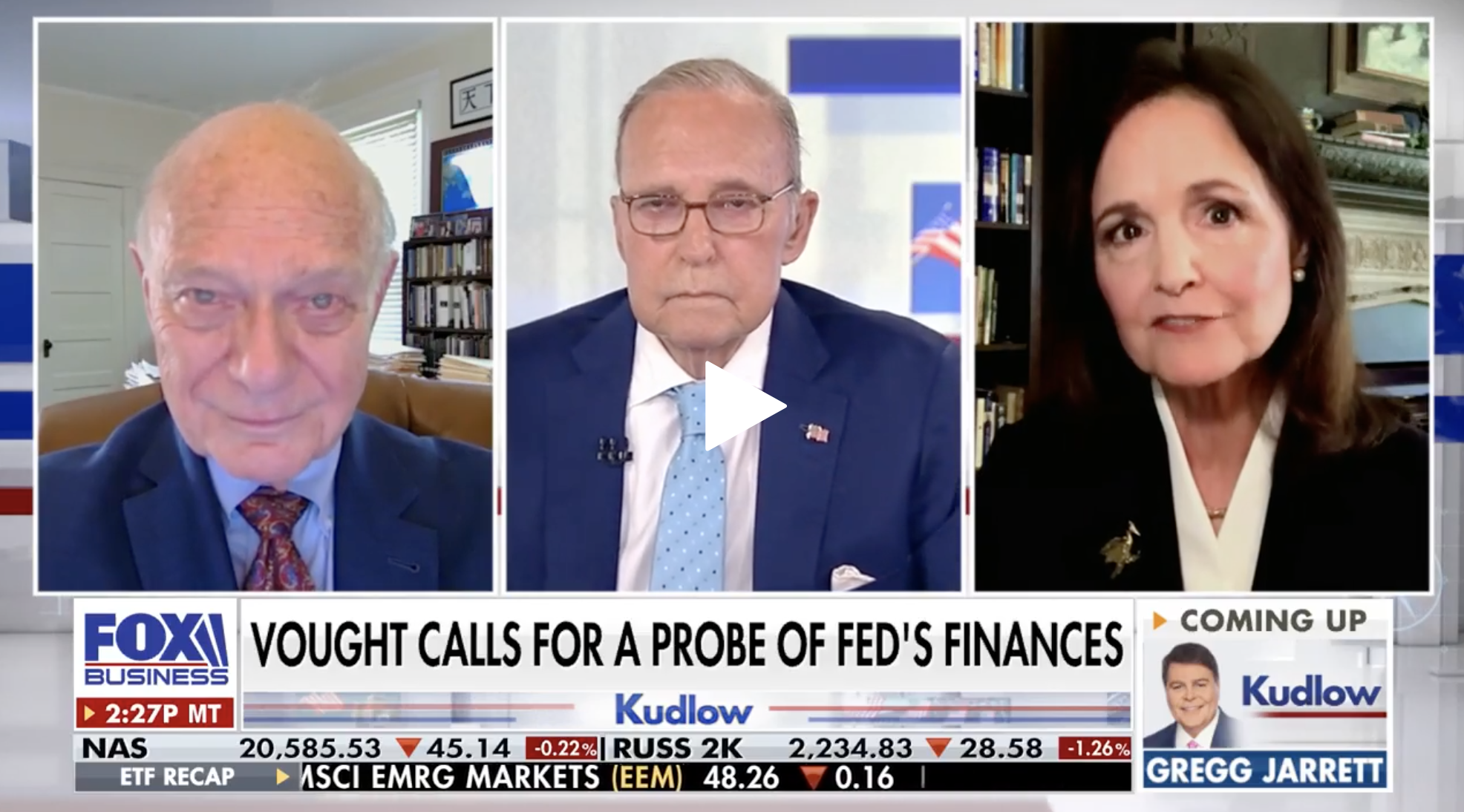
The Fed is ‘vulnerable’ on several fronts, has ‘a lot to answer for,’ says expert
Panelists Judy Shelton and Alex Pollock discuss concerns around the Federal Reserve and calls for Chair Jerome Powell’s resignation on ‘Kudlow.’
Fannie Mae and Freddie Mac’s public risk could become private profit again
Published in The Hill and RealClear Markets.
Fannie Mae and Freddie Mac are the dominant companies in U.S. housing finance, which is the biggest credit market after government debt. They are huge, with combined assets totaling $7.8 trillion.
Fannie and Freddie used to be government-sponsored enterprises. This privileged status led both of them to great financial success, combined with formidable political clout. Fannie, in particular, was a notable Washington bully.
But having taken on excessive credit risk in the great housing bubble, they both failed in 2008, were put into and remain in government conservatorship, meaning total government control, and were bailed out by $190 billion in stock purchases by the U.S. Treasury, which means the government became and remains their dominant equity investor.
So, Fannie and Freddie are no longer government-sponsored enterprises and have not been since 2008. Now, they are instead government-owned and government-controlled entities.
Former Rep J.J. Pickle (D-Texas) perfectly summed up the essence of Fannie and Freddie, and the key concept of a government-sponsored entity, a generation ago: “The risk is 99 percent public and the profit is 100 percent private.”
This government-sponsored enterprise combination is economically undesirable but highly tempting to politicians and highly attractive to the investors whose profits expand from receiving the government subsidy involved.
This handsome subsidy is cleverly achieved by creating a corporation with private shareholders who get the profit, but which also has a guarantee of its obligations provided for free by the U.S. Treasury, and therefore by the taxpayers.
When things go well, the huge value of using the government’s credit flows through to the shareholders, while the Treasury and the taxpayers are stuck with the risk and the cost of any failure. What an investment opportunity!
So it is no surprise that some large investors are trying to get Fannie and Freddie made back into government-sponsored enterprises, the stock of which these investors could own, thus reaping billions per year from subsidies created by the government guarantee.
The Trump administration has expressed support for this investment idea, and the president himself has supported the government guarantee involved. There has been a related run-up in the price of the portion of Fannie and Freddie equity still in private hands.
Of course, those who want to bring back Fannie and Freddie as government-sponsored enterprises have to address a tricky element of the guarantee from the government, because they need it to be real and fully believed in by the global purchasers of their mortgage-backed securities and debt.
But at the same time, the Treasury needs to keep Fannie and Freddie off the government’s books by pretending it isn’t really a guarantee. Can they achieve both?
A solution to this conundrum was found in 1968, when the Johnson administration, faced with rising deficits and debt from the rapid expansion of both war and welfare, wanted to get Fannie off its books, while at the same time expanding mortgage credit.
Its solution was to make Fannie’s stock owned by private investors, but to provide government support that the market would accept as a guarantee, without issuing a formal guarantee. In the words of a memorandum of that time, held today in the Lyndon B. Johnson Library, this would “constitute indirect — but explicitly, not direct — Federal guarantees.”
With this idea, it turned Fannie into a government-sponsored enterprise. Then Freddie was created in 1970.
So, “explicitly not direct” was the resulting guarantee that Fannie and Freddie were required by statute to include in each of their offering memoranda that “securities, together with interest thereon, are not guaranteed by the United States and do not constitute a debt or obligation of the United States.”
That seems clear, but nobody at all believed it, and because nobody believed it, the Johnson administration’s scheme worked.
Fannie and later Freddie and their debt were kept off budget while they mightily expanded until their 2008 collapse. At that point, the reality of the guarantee was decisively demonstrated by the complete protection of all creditors of the insolvent companies, even subordinated debt holders.
What now? The worst case would be to turn Fannie and Freddie back into government-sponsored enterprises again, with a free government guarantee to subsidize the investors.
Theoretically, a good outcome would be to return to private ownership, but also require Fannie and Freddie to pay a fair market price for their government guarantee. Unfortunately, as Ed Pinto and I have shown, the fair price for the guarantee is so high that the stock becomes unattractive to investors.
Fannie and Freddie are far too big to fail, so the government cannot get out of its “implicit” guarantee. It looks like the best case at this point is to leave them as government-owned and government-controlled entities, while steadily working to shrink their distorting impact on housing markets, their risk to taxpayers and the inflation of house prices they cause.
The Federal Reserve Is Covering Up Its Financial Losses
Published by The Mises Institute’s Radio Rothbard.
Alex Pollock, an expert on Federal Reserve policy, joins us to talk about how the Fed has backed itself into a very bad financial corner, and there is no painless way out.
Duplicity at the Fed
Published in Law & Liberty with Paul H. Kupiec
The Federal Reserve is losing billions of taxpayer dollars, and concealing this through dubious accounting practices.
The Federal Reserve System has unique powers among Congressionally-chartered government bodies, and yet its powers do not include the authority to borrow money at taxpayer expense to pay for huge accumulating losses without Congressional approval. The Fed has invented its own unique financial accounting standard to disguise the fact that, under normal accounting rules, the system is deeply insolvent. From 2022 through 2025, the Fed system’s accumulated losses have completely consumed the system’s capital and forced the Fed to borrow over $185 billion more than the Fed owns in assets just to pay its bills—a fact it intentionally tries to hide from the public.
Rather than earning seigniorage profits for taxpayers, something the Fed did for more than 100 years, the present-day Fed has instead accumulated losses of the staggering amount of $231 billion. These losses reflect Fed expenses that, between 2022 and 2024, included over $420 billion paid to banks in interest on their deposits held at the Fed and over $185 billion in interest paid to other financial institutions on repurchase agreement loans; in addition, the Fed made over $4 billion in dividend payments to Fed member banks on their Fed district bank stock.
However unique, the Fed ultimately is a government agency. When it is making losses, the Fed’s annual expenses are paid by taxpayers and are a direct cost of running the government. When Fed expenses exceed Fed revenues, the Fed borrows to pay its bills. When accumulated Fed losses exceed the Fed’s capital—as they do today—the amount the Fed has borrowed in excess of the value of the Fed’s assets is a contingent taxpayer liability.
Under current accounting standards, neither Fed cash losses nor the taxpayer contingent liability created by accumulating Fed losses are reflected in the annual federal budget. This is problematic. The Fed should be transparent and accountable to taxpayers for its expenditures, just like any other federal agency—but it clearly is not. There is a simple, if politically difficult, two-part solution: (1) The Fed should be required to prepare its financial statements using generally accepted accounting standards; and, (2) The Fed’s consolidated system operating costs and the contingent taxpayer liabilities associated with its negative capital should be reported in the notes to the annual federal budget.
The Fed constantly asserts its “independence.” Fed independence may be interpreted to mean that, except in national emergencies, the Fed should be permitted to set interest rates without executive branch interference. The president and designees are free to express displeasure with the Fed’s monetary policy, but they should not be allowed to force the Fed to adopt a particular monetary policy preferred by the president.
However, the Fed remains unquestionably accountable to Congress, which retains plenary oversight responsibility and authority over it. Congress is not only free to criticize any aspect of the Federal Reserve, but also to pass legislation to direct how the Fed conducts monetary policy, manages its risk, accounts for its results, or discharges any of its other duties. As Thomas McCabe, then Chairman of the Federal Reserve Board, expressed with great clarity: “The Federal Reserve Act … provided that the Federal Reserve should have independent status in the government structure, reporting directly to the Congress.”
Until recently, consolidated Fed system revenues exceeded its operating expenses and member bank dividend payments, allowing the Fed to remit billions of dollars to the US Treasury each month. Now, the Fed has enormous and continuing cash operating losses. By May 28, 2025, the Fed’s operating losses have accumulated to reach a mind-numbing value of $231 billion.
There is no explicit provision in the Federal Reserve Act or other law that empowers the Fed to borrow money at taxpayer expense, off the books of the Federal government, to pay expenses in excess of Fed income without Congressional approval. Yet the Fed has been doing exactly that since March 2023, when its accumulated losses surpassed its total capital. To date, the Fed’s liabilities exceed the book value of its assets by $185 billion. The Fed has had to borrow this amount to pay its expenses and to pay dividends to its private shareholders, while it has no profits and no retained earnings.
Fed member bank dividends are cumulative by law. However, the act of borrowing to pay rather than cumulate dividends payable puts member bank interests ahead of taxpayers. Moreover, the payment of dividends in the absence of revenues in excess of expenses seemingly violates the Federal Reserve Act, which explicitly conditions member bank dividend payments: “After all necessary expenses of a Federal reserve bank have been paid or provided for.” Under this requirement, if the Fed is losing money after paying its expenses, there is obviously nothing left to pay dividends.
Instead of reporting its financial results in a forthright manner, the Fed adopted nonstandard accounting practices to hide the financial impact of its accumulating cash losses. It classifies its accumulating cash losses as a “deferred asset” so that its reported retained earnings remain unchanged despite its massive losses. The Fed uses accounting rules of its own creation to obscure the fact that the consolidated Federal Reserve System has negative capital and is borrowing scores of billions of dollars off-budget to pay interest and dividends to banks and other financial institutions.
In short, the Fed’s accounting pretends that its losses are an asset and that its losses do not reduce its capital. The Fed adopted this accounting practice in 2011 when it recognized that its massive “quantitative easing” securities purchases could potentially create Fed losses under its post-financial crisis policy of paying interest on bank reserves, as indeed they did in time. Its solution was “just change the accounting” so cash losses would misleadingly appear not to affect the Fed’s capital. To add insult to injury, the Fed’s annual operating expenses and accumulated borrowings are not included in official federal budget accounts, even though these borrowings are ultimately a taxpayer liability resulting from a real federal government operating expense.
Congress explicitly delegated the power to set the accounting standards used to prepare the financial statements of the government agencies that are consolidated in the federal budget to the Federal Accounting Standards Advisory Board (FASAB). The FASAB designed its accounting standard to facilitate public evaluation of each reporting entity’s services and costs as well as the management of its assets and liabilities, thereby ensuring that the entity’s officials are “publicly accountable for monies raised through taxes and other means.” The Government Accountability Office, the Office of Management and Budget, and the Treasury Department are jointly responsible for overseeing the FASAB.
For federal budget accounting purposes, the FASAB classifies the Fed as a “disclosure entity”—an entity whose budgetary impact is recognized only in the notes to federal government consolidated accounts, and in the Fed’s case, recognized only to the extent that it remits revenues to the US Treasury. The Fed’s operating expenses are not separately disclosed.
If you peruse the notes to the consolidated federal budget financial statements and are not deeply invested in legal minutiae, you might think that the consolidated Federal Reserve System made money in 2023 and 2024. By law, Fed remittances to the Treasury are made separately by the twelve district reserve banks, and only a few district reserve banks had revenues that exceeded expenses and dividend payments in 2023 and 2024. These cash remittances to the Treasury were overwhelmed by tens of billions of cash operating losses at the remaining federal reserve district banks, and yet the Fed’s consolidated cash losses, despite being an undeniable cost of government, do not appear anywhere in the notes to the combined federal budget accounts.
While the FASAB does not set accounting standards for disclosure entities, regulators have required federal government-sponsored corporations such as the Federal Home Loan Banks, Fannie Mae, and Freddie Mac to use Securities and Exchange Commission-approved public accounting standards when preparing their financial statements, notwithstanding the fact that they, too, are federal budget disclosure entities. As far as we can determine, the Federal Reserve’s claim that it has the power to determine its own accounting standards without the external input or approval of a duly designated accounting standard-setting body is unique among large federal budget disclosure entities.
The private ownership of the stock of the Federal Reserve’s district banks explains why the Fed is not consolidated in federal budget accounts. The stock of the twelve district Federal Reserve banks is 100 percent owned by their private member banks. The shareholders elect two-thirds of each bank’s board of directors, which appoints the president of the bank with Federal Reserve Board approval. These privately owned twelve district banks hold member bank deposits, issue Federal Reserve Notes, borrow on repurchase agreements, lend to banks, process vast payment transactions, invest a combined more than $6 trillion in Treasury debt and mortgage-backed securities, and generate the combined Federal Reserve System profits or losses.
The combined operating loss of $231 billion so far suffered by the Federal Reserve banks has accrued because the interest the Fed pays on deposits and borrowings vastly exceeds the interest it earns on its assets. For the combined system and nine of the twelve district banks individually, the accumulated operating losses by far exceed the paid-in capital and surplus, making nine district banks and the system technically insolvent on a GAAP basis.
Under the Federal Reserve Act, the stockholders of the insolvent district reserve banks—Federal Reserve member banks—are in part liable for the capital shortfall of their insolvent district bank. According to the Act, should there be a need to fortify any Federal Reserve district bank’s resources, member banks are subject to call on the second half of their equity subscription [12 U.S.C. § 282]. For the Fed shareholders in total, the amount subject to call is $39 billion. The Federal Reserve Board could simply issue a call for this additional capital, and the Fed member banks would have to comply.
In addition, the Act includes the little-known shareholder contingent liability that member banks may be required to contribute an additional amount to cover district reserve bank operating losses up to an amount equal to their membership subscription [12 U.S.C. § 502]. This would be an assessment, not a stock purchase. For Fed shareholders in total, the current maximum potential assessment is $78 billion. The Fed needs only to say, “Send us the money!”
But the Fed has not exercised its authority either to call additional member bank capital contributions or to impose assessments authorized by the Act to make up for some of the losses. Instead of raising capital, the Fed created its nonstandard accounting that allows it to hide the fact that the combined system and nine of the twelve district banks are GAAP insolvent. Unbelievably, the book surplus account balances the Fed reports are not reduced by its giant operating losses, thanks to the “deferred asset” gambit. The dividends to member banks that the Fed keeps paying despite the lack of profits and negative real capital are also treated as part of the ignominious “deferred asset.”
While the Fed’s published financial statements suggest that operating losses can be covered merely by creating an accounting entry, the “deferred asset,” in reality the Fed raises the money that corresponds to this deferred asset by issuing new Federal Reserve Notes, or borrowing from banks in the form of deposits, or borrowing from nonbanks through repurchase contracts, or letting assets mature and using the cash to pay expenses and dividends while not reducing the corresponding borrowings.
All of these actions increase the debt of the consolidated US government and are real costs to the taxpayers, even though consolidated federal budget accounting does not recognize these costs.
Federal Reserve Notes are explicitly guaranteed by the US government and must by law be collateralized by the Fed, but deposits in a district Federal Reserve bank are neither guaranteed nor collateralized, nor are they joint obligations of the other district banks. These deposits would legally be subject to losses without additional shareholder contributions and/or taxpayer support. The fact that Fed member banks maintain trillions in deposits at GAAP insolvent Federal Reserve district banks demonstrates that member banks believe that their deposits are fully protected by an implicit federal government guarantee, as indeed they are. Thus, the Federal Reserve’s negative capital position, which has been created over time by paying banks and other financial institutions more in interest and dividend payments than the Fed’s income, is in fact a taxpayer liability.
The Federal Reserve should not be permitted to make up its own accounting rules in order to hide its losses and negative capital. Taxpayers should demand that Congress require that the Fed produce financial statements that conform to generally accepted accounting standards, and that the notes to consolidated federal budget accounts report Fed operating losses and member bank dividend payments separately from Fed remittances to the Treasury. Such disclosures are necessary to promote public accountability and accounting probity for all parts of the government, which includes the Fed.
The current Federal Reserve accounting standard and federal budget disclosures hide taxpayer material financial risk created by the operations of the Federal Reserve, with its losses of $231 billion and negative capital of $185 billion. They also obscure the interests and potential liability of the private shareholders of the Federal Reserve district banks, which compete with taxpayers’ interests and should be accurately represented in the Fed’s reported capital accounts.
Who might object to our straightforward proposed changes in Fed and federal government accounting standards? Why the Fed, banks, financial institutions, and perhaps even some in Congress—who are unwilling to strengthen Fed oversight. Notwithstanding the almost certain political push-back, these changes are needed as the Federal Reserve is far too important to the US government and the country to continue using its current duplicitous accounting practices.
After more than fifty years of U.S.government-sponsored housing finance, why has home ownership not increased and why are houses unaffordable?
Published in Housing Finance International Journal.
The U.S. housing finance system is unique in the world by being dominated by the Government-Sponsored Enterprises (GSEs), Fannie Mae and Freddie Mac. GSEs are a really poor and dangerous idea. By definition, they combine private ownership of their stock with special privileges, including most importantly a guarantee of their obligations by the government, i.e. the taxpayers. This guarantee is said to be only “implicit,” but is fully real, as history demonstrates. It naturally leads to overexpansion of mortgage credit and inflation of house prices.
Fannie was made into a GSE in 1968. Freddie was created as a GSE in 1970. Thus, we in the U.S. have had for well over half a century these two expanding government-guaranteed and government-subsidized attempts to increase home ownership and make it more affordable. But the home ownership rate has increased by only 1 percentage point during that long time.
Over the last five decades, the GSEs became enormous: Fannie’s total assets are $4.4 trillion as of March 2025, and Freddie’s are $3.4 trillion, giving them combined assets of $7.8 trillion. That’s “trillion” with a “T.” All the risk is guaranteed by the government. The GSEs are a huge and distorting commitment to housing finance which burdens our over-indebted government’s credit, although the partial private ownership allows the GSE obligations to be kept off the government’s books.
Fannie and Freddie have been majority-owned by the U.S. Treasury since they were bailed out by the government in the panic of 2008, and the Treasury has an option to acquire up to 79.9% of their common shares for the price of $0.00001 per share—in other words, essentially for free. But both these GSEs still have private shareholders, too. Various proposals to make Fannie and Freddie’s stock fully privately owned have been and are being made, but this would not change the fundamental problem at all: they would still be GSEs.
In addition to the giant Fannie and Freddie, there is much more government intervention and risk-shifting to the taxpayers in the U.S. housing finance system. There is Ginnie Mae, also created in 1968, which is a government corporation, with 100% of its stock owned by the U.S. Treasury. Ginnie as of March 2025 guarantees $2.7 trillion (again with a “T”) of mortgages and is itself fully guaranteed by the taxpayers.
If we add Fannie, Freddie and Ginnie together, we find these government-guaranteed organizations represent the staggering sum of $10.4 trillion. In round numbers, the U.S. government guarantees $10 trillion out of total outstanding residential mortgages of $14 trillion: in other words, the government guarantees about 70% of the mortgage credit in the country. In my opinion, this is financially ridiculous: no national mortgage market worthy of the name should have to be 70% government guaranteed.
There is more U.S. government mortgage presence on top of that. The Federal Home Loan Banks (FHLBs), which are also GSEs, lend money to finance the holding of mortgages by financial institutions. The FHLBs have total assets of $1.2 trillion. The $1.1 trillion in debt they issue to fund themselves is also guaranteed by the government. This brings the total government backing of housing finance to about $11 trillion.
Then there is the Federal Housing Administration (FHA), the government’s official sub-prime mortgage lender. It insures the credit risk of higher risk mortgage loans, with insurance in force of about $1.5 trillion. The Veterans Administration provides mortgage credit insurance to members and veterans of U.S. armed services. There are about $1 trillion in loans with VA insurance. Any deficits of the FHA and VA programs are funded by the Treasury. Since most FHA and VA loans are securitized by Ginnie, which adds its guarantee to their insurance, they are for the most part already included in the Ginnie numbers.
Finally, the U.S. central bank, the Federal Reserve, is a huge investor in residential mortgages, with $2.2 trillion on its balance sheet at the end of April 2025. In my opinion, the Fed should own zero mortgages, but instead it owns about 15% of the entire market. The Fed buys mortgages in the form of securities guaranteed by Fannie, Freddie and Ginnie, so the government had the credit risk already. But by buying them, the Fed adds to the credit risk an enormous interest rate risk to the government, since it makes 30-year fixed rate investments and funds them short. I estimate that this now upside-down interest rate risk gamble has lost approximately $100 billion so far for the Fed, which means also for the government and the taxpayers—and continues to lose about $40 billion a year.
What has the massive U.S. government intervention in mortgage lending achieved in the way of improved home ownership? The U.S. home ownership rate was about 64% in 1970 and it is 65% in 2025. It has hardly increased in 55 years, all the government and government-sponsored housing finance notwithstanding.
The government intervention has, however, helped inflate two 21st century house price bubbles. The first peaked in 2006 and led to the financial crisis of 2007-09. The second sent average house prices far above their 2006 peak, including rising at over 18% in 2021. This has led to their continuing unaffordable levels, especially for young families trying 22 HOUSING FINANCE INTERNATIONAL Summer 2025 Regional round up: news from around the globe to buy their first house. Although the rate of increase has now become moderate, average house prices are still rising, at the annualized rate of 3% in April 2025. With inflation at 2.3% for that month, average house prices are also still going up in real terms.
It is often observed that U.S. house prices are simply too high, which helps explain why sales of existing houses in 2024 were the fewest since 1995, even though the population is 27% larger than then.
We can conclude that the vast scale of U.S. government intervention in guaranteeing and subsidizing of mortgage debt has been a mistake. The housing finance system should grow more private, with the market share of the GSEs being systematically reduced and the government’s overall role getting smaller. The Federal Reserve’s target for investment in mortgages should be zero. The government should target a substantial reduction in the percentage of the mortgage market it guarantees. As a first estimate, I recommend a reduction to 20%, down from the current egregious 70%.
Event video: The Great Debate: How to Modernize Financial Regulation and Create Economic Stability in a Digital Age
Join George Mason University’s (GMU) Center for Assurance Research and Engineering (CARE), the Financial Technology & Cybersecurity Center (Center), GMU’s School of Business, and a host of experts for a wide ranging discussion of what a financial regulatory structure equipped to deal with the realities of today’s financial services sector should look like.
The Great Debate: How to Modernize Financial Regulation and Create Economic Stability in a Digital Age
Co-Chairs:
Dr. Jean-Pierre Auffret
Director, Research Partnerships, Costello College of Business, George Mason University; Director, Center for Assurance Research and Engineering (CARE), College of Engineering & Computing, George Mason
Thomas P. Vartanian
Executive Director of the Financial Technology & Cybersecurity Center
Author, 200 Years of American Financial Panics, Crashes, Recessions and Depressions, And the Technology That Will Change It All; The Unhackable Internet: How Rebuilding Cyberspace Can Create Real Security and Prevent Financial Collapse
Agenda:
8:30 – 8:40 a.m. Welcome and Overview
8:40 – 9:10 a.m. Why Don’t We See Financial Sector Crises Coming & How Do We Make Supervision Work Better?
Keynote Remarks:
Elizabeth McCaul
Former Member Supervisory Board, European Central Bank
Former Chair, New York State Banking Board and Superintendent of Banks
9:10 – 10:10 a.m. Panel:
Greg Baer
President & CEO, Bank Policy Institute
Gary Gorton
Professor Emeritus of Management & Finance
Yale School of Management
Author, Misunderstanding Financial Crises: Why we don’t see them coming
Elizabeth McCaul
Alex Pollock
Senior Fellow, Mises Institute
10:10 – 10:35 a.m. In Person Exclusive: Faculty Donut Networking Break
featuring Elizabeth McCaul, William Isaac, Randal Quarles
10:35 – 11:25 a.m. Time to Regulate Cryptocurrency? Investments, Money or Both?
John Reed Stark
John Reed Stark Consulting LLC
Former Chief, SEC Office of Internet Enforcement
Coy Garrison
Partner, Steptoe LLP
Former Counsel to SEC Commissioner Hester Peirce
11:25 a.m. – 12:25 p.m. Regulation of Nonbank Financial Institutions and FinTechs
Michele Alt
Co-Founder and Managing Director, Klaros Group
Dan Swislow
Director of Policy and Government Affairs, Mercury
Caitlin Long
Founder & CEO, Custodia Bank
12:25 – 1:40 p.m. Buffet Lunch
12:40 – 1:20 p.m. Fireside Chat
Randal Quarles
Chairman & Founder, The Cynosure Group
Former Vice Chair for Supervision, Federal Reserve Board
Thomas Vartanian
1:40 – 2:40 p.m. Building a New Regulatory Model
Elizabeth McCaul
Todd Zywicki
George Mason University Foundation Professor of Law
George Mason University, Antonin Scalia Law School
[Additional panelist to be announced]
2:40 – 3:05 p.m. In Person Exclusive: Faculty Donut Networking Break
featuring Robert Ledig, Elizabeth McCaul, Todd Zywicki
3:05 – 3:40 p.m. Rethinking Deposit Insurance – Uninsured Deposits and other Threats to Financial Stability
Keynote Remarks:
William Isaac
Chairman, Secura/Isaac Group
Former Chairman FDIC
3:40 – 4:30 p.m. Panel:
Robert Ledig
Managing Director, Financial Technology & Cybersecurity Center
Alison Touhey
SVP, Bank Funding Policy, American Bankers Association
Richard Wald
Vice Chairman, Emigrant Bank
4:30 – 5:15 p.m. Leveraging AI to Improve Financial Regulation
Jo Ann Barefoot
CEO & Cofounder at Alliance for Innovative Regulation
Author, The case for placing AI at the heart of digitally robust financial regulation
Dr. Jon Danielsson
Director of the Systemic Risk Centre, London School of Economics
Author, The Illusion of Control: Why Financial Crises Happen and What We Can (and Can’t) Do About It
[Additional panelist to be announced]
5:15 – 5:30 pm Wrap Up
Penny-Ante Inflation?
Quoted in The New York Sun:
That’s because under a fiat money regime, currency loses any relation to the value of the circulating medium. The cost of the metals that now comprise a penny — mostly zinc, with a dash of copper — now exceeds the face value of the coin. “The demise of the penny,” a former Treasury official, Alex Pollock, a Sun contributor, tells Mr. Grant’s newsletter, “is a pointed reminder of the Federal Reserve’s unrelenting depreciation of the U.S. currency.”
Mr. Pollock takes 1950 as a point of comparison to explain the penny’s fate. In the 75 years since then, he says, “the purchasing power of a penny has dropped by 93 percent,” meaning that today’s coin “is worth about 1/13 of a 1950 penny.” He traces the penny’s doom to the fact that “nobody in 1950 thought they needed a coin worth 1/13th of a cent and we don’t need a coin of such little value, either.”
Following this logic, Mr. Pollock adds that “a nickel in 2025 is worth about 3/8 of a 1950 penny, and a current dime is worth 25 percent less than the former penny.” Is the writing on the wall for these coins, too? “With the Fed’s earnest promise of perpetual inflation, we soon won’t need nickels and dimes,” Mr. Pollock reckons. “Meantime, the current quarter is worth 1.8 pennies of 1950,” he adds.
So it is that, in Mr. Pollock’s telling, “the Fed has transformed two bits into less than two cents.” He marvels that “continuous inflation has remarkable shrinking power.” It marks the vindication, too, of a warning in 1966, in the twilight years of honest money, by National Review’s William Rickenbacker. He lamented how America had just removed the silver from its coinage, “practically unchanged from the birth of the republic.”
Letter: Questions need to be asked about the Federal Reserve’s losses
Published in the Financial Times.
Brian James Gross’s loyal defence of the Federal Reserve’s losses (“Why commercial banking logic won’t apply to the Fed”, Letters, May 31) doesn’t ever mention the egregious amount of these losses — $231bn at the end of May and still growing — but it does get one thing right: that the Fed is not “a” bank. No, the Fed combines 12 government-sponsored banks, each of which has loans, investments, deposits, profits or losses, and stockholders that are private banks.
The stockholders have contributed a combined $39bn in paid-in capital, on which they expect and so far do receive dividends; they might be surprised to find out that their capital is “irrelevant”. In nine of the 12 Federal Reserve banks, the losses exceed the total capital.
These losses are not mere “accounting losses”, but cash operating losses. The losses are an expense to the consolidated government and to the taxpayers, and increase the national debt. In addition, the 12 banks have about $1tn in mark-to-market losses on their investments, suggesting more operating losses in the future.
The Federal Reserve is a profit-seeking entity, though not a profit maximiser, intentionally designed to make money for the government by issuing non-interest bearing currency and investing in interest-bearing assets. That the combined Federal Reserve banks instead are now losing so much money is because they took enormous interest rate risk, lending long and borrowing short, and are upside down on the trade.
The Fed, with its component banks, is not “sovereign”, nor does it have “autonomy”, as Gross suggests (although it wishes it did!), but is entirely accountable to and subject to the elected representatives of the people in Congress assembled. Congress should surely, just as Brendan Greeley said in the original FT opinion piece, be making judgments about the Fed’s losses — how they are deficit-increasing and national debt-increasing, whether Federal Reserve banks should continue to pay dividends when they have no profits, and whether something needs to be done about the Fed’s capital, which on a combined basis is in reality negative $185bn.
Alex J Pollock
Senior Fellow, Mises Institute,
Lake Forest, IL, US
Art of Default
Published in Grant's Interest Rate Observer.
"The demise of the penny," reader Alex J. Pollock reflects,
is a pointed reminder of the Federal Reserve's unrelenting depreciation of the U.S. currency. Taking 1950 as a convenient starting date, that being 75 years or about one lifetime ago, the purchasing power of a penny has dropped by 93% as the Consumer Price Index has gone in round numbers from 24 to 321, so a penny in 2025 is worth about ¹⁄₁₃ of a 1950 penny.
Naturally, nobody in 1950 thought they needed a coin worth ¹⁄₁₃ᵗʰ of a cent and we don't need a coin of such little value, either. A nickel in 2025 is worth about ³⁄₈ of a 1950 penny, and a current dime is worth 25% less than the former penny. With the Fed's earnest promise of perpetual inflation, we soon won't need nickels and dimes. Meantime, the current quarter is worth 1.8 pennies of 1950: The Fed has transformed two bits into less than two cents. Continuous inflation has remarkable shrinking power.
It’s Time for Shareholders of the New York Federal Reserve Bank To Receive a Call for Capital
The New York member of the Federal Reserve System has racked up by far the biggest losses in the Federal Reserve System.
Published in The New York Sun.
This column is about the capital deficit confronting the biggest among the 12 Federal Reserve Banks. Although we often refer to our central bank in the singular as the “Fed,” the system includes twelve different Federal Reserve Banks, each a separate corporation. Each has its own shareholders, directors, officers, balance sheet, profit and loss performance, and capital — or recently, absence of capital.
New York has always had a special and superior position, the most prominent and prestigious of the twelve Federal Reserve Banks. All other FRBs are required by statute to take turns serving as voting members of the Fed’s super-powerful Federal Open Market Committee, but New York has a permanent seat on the FOMC. Moreover, its president is always the Vice Chairman of the committee. New York carries out the open market buying and selling on behalf of the entire Fed.
In the early years of the Federal Reserve, the most influential officer of the System was Benjamin Strong, the Governor of the New York Fed 1914-1928 and “a dominant force in U.S. monetary and banking affairs.” Strong, for example, negotiated directly with the Governor of the Bank of England, the top central bank in the world until surpassed by the Fed.
Note the matching titles at that time. The heads of the individual FRBs were originally called “Governors,” after the style of the head of the Bank of England. In 1935 they had their titles downgraded to “president” so the members of the Federal Reserve Board could become “governors.”
New York is far and away the biggest FRB, with massive total assets of $3.4 trillion. This is more than all the other eleven FRBs put together, more than five times as big as the No. 2 reserve bank, San Francisco, and 67 times as big as the No. 12, Minneapolis. New York owns the most bonds and mortgage securities of any FRB and has the biggest naked interest rate risk position of long invested vs. short funded.
In recent times, New York has added another distinction, one less desirable. It has far and away the biggest losses and the most deeply negative capital of any FRB. Since the fourth quarter of 2022, the Fed on a combined basis has been losing previously unimaginable amounts of money — its aggregate operating losses as of the end of April 2025 are a staggering $228 billion.
Of that amount, the FRB New York alone has suffered operating losses of $137 billion, a disproportionate share of the Federal Reserve System. While it has 51 percent of the combined Fed assets, New York has 60 percent of the operating losses.
When the FRBs marked their investments to market at year-end 2024, the results of which they disclose but do not include in their financial statements, the combined Fed had a market value loss of more than $1 trillion. The FRB of New York alone had a market value loss on its investments of $572 billion, 54 percent of the System total.
The New York Fed shows on its official balance sheet extremely little capital relative to its huge assets, about $15 billion in capital or less than half a percentage point of assets. In reality, the $15 billion is not there — New York’s losses of $137 billion mean the capital has been lost nine times over. Fundamental accounting requires that losses be subtracted from capital, so the FRB New York’s real capital is $15 billion minus $137 billion or negative $122 billion. This is 66 percent of the System’s combined negative capital.
What should the stockholders of the FRB New York think? They own equity in a technically insolvent corporation. They are still getting dividends from their FRB, but while such dividends are required by law to come from profits, there are no profits and there is no capital. Does the Audit Committee of the FRB New York consider that?
Under the Federal Reserve Act, the stockholders are subject to a capital call at any time requiring them to buy more stock in their FRB. Should such a call be made on the New York stockholders?
The stockholders are also subject under the act to being assessed to offset an FRB’s losses for up to twice their current investment. Are the Audit Committees of the New York stockholder banks aware of that?
What would Benjamin Strong have thought of the finances of the current New York Fed?
From Whom Is the Fed Independent? To Whom Is It Accountable?
Published in The Federalist Society.
The Federal Reserve and its supporters constantly declare that the Fed is and should be “independent.” Whether it is or should be independent of the elected President of the United States is once again a hot issue—as it has been numerous times before in history. Whether the President can fire the Fed Chairman is now a particularly debated question. A more fundamental question is whether any agency of the federal government—including the central bank—can in our constitutional republic be an independent power subject only to itself.
The constitutional bedrock of American government, and of American political philosophy, is that all parts of the government are subject to checks and balances from other parts. This must apply to the Fed as well as to all other government entities. Should one immensely powerful part of the government, the Fed, be exempt from the essential principle of checks and balances? The answer is no. But we have to specify from whom the Fed is independent and to whom it is accountable.
My conclusion is that the Fed is and should be independent of the President, but that the Fed is and should be accountable to (thus not independent of) the Congress.
Congress and the Fed
The Congress is without question the possessor of the Constitutional Money Power: “To coin money [and] regulate the value thereof.” The Congress also possesses the Taxing Power: “To lay and collect taxes.” The Fed is a critical part of both and thus is subject to Congress. We must include taxation because the inflation the Fed creates is in fact a tax; it takes the people’s purchasing power and transfers it to the government.
In addition, the Fed is now running massive losses. As April 2025 ends, the Fed’s accumulated operating losses have reached the astonishing amount of $227 billion. Besides far exceeding the Fed’s capital and rendering it technically insolvent, these losses are a growing hit to the taxpayers. They increase the federal deficit and increase the national debt—both key congressional responsibilities. The Fed has on top of this a more than $1 trillion market value loss on its investments. Imposing these losses and this risk on the government’s finances should by itself sink any claim that the Fed should be completely independent, especially when the Fed has manipulated its accounting in embarrassingly dubious fashion to hide its resulting negative capital.
Further, we must consider that the Fed’s monetary policy is in essence an attempt at central planning and price fixing, using changing and debatable theories and data reflecting the past, with inevitable political effects. There is no data on the future. Neither the Fed nor anybody else has the knowledge of the future which would be required to “manage the economy.” The Fed’s efforts—no matter how much intelligence, data from the past, and good intentions are applied—share with all tries at government central planning the impossibility of the requisite knowledge, as demonstrated by Ludwig von Mises and Friedrich Hayek.
As one notable example, the Fed could not know what the results would be of its unprecedented monetizing of $8 trillion in long-term Treasury debt and 30-year fixed-rate mortgages. As it turned out, this included stoking a new house price bubble. This bloating of its balance sheet by “quantitative easing” was accurately described by former Fed Chairman Ben Bernanke as “a gamble.”
The Fed does not and cannot know what the results of such gambles will be; it is flying by the seat of its pants.
Likewise, neither the Fed nor anybody else can know—but can only guess about—what the celebrated “neutral rate of interest” is or will be. That this theoretical neutral rate is called “r-star” gave rise to this brilliant and honest aphorism of Fed Chairman Jerome Powell: “We are navigating by the stars under cloudy skies.”
While flying by the seat of your pants, gambling with trillions of taxpayer dollars, and navigating by the stars under cloudy skies, how can you claim you should be independent? In my view, you can’t. Accountability to the Congress is required.
Turning to political philosophy, we should recall the conclusions of the congressional study, The Federal Reserve After Fifty Years, published in 1964 under the leadership of Wright Patman, then Chairman of the House Committee on Banking and Currency:
“An independent central bank is essentially undemocratic.”
“Americans have been against ideas and institutions which smack of government by philosopher kings.”
“To the extent that the [Federal Reserve] Board operates autonomously, it would seem to run counter to another principle of our constitutional order—that of the accountability of power.”
These conclusions seem to me correct.
The President and the Fed
It is natural that the President and his Treasury Department should want to control the Fed, since that would give them the power to keep spending money when they are in deficit, by having the Fed print it up and lend it to the Treasury. Presidents of both parties have often wanted lower, or at least not higher, interest rates for political purposes, including financing wars and winning elections, and they have used their influence with the Fed accordingly.
The Treasury Department of course likes lower interest rates on government securities, which reduce the cost of the debt it issues and reduce the amount of new borrowing needed to pay the interest on the old debt. To make the executive the boss of the Fed is to make the borrower the boss of the lender.
Nonetheless, for extended times in Federal Reserve history, especially during major wars and economic emergencies, the Fed has been subservient to the Treasury Department. This began when the Fed was three years old with the American entry into the First World War in 1917. During these times, the Fed devoted itself loyally to financing the government’s deficits as needed. It did so most recently during the Covid-19 economic crisis of 2020-21. Will the Fed repeat this performance in the future? Given a war or emergency big enough, it will.
Historically, under master politician Franklin Roosevelt, “The Treasury controlled most decisions,” and the Federal Reserve “was in the backseat,” according to Allan Meltzer’s magisterial A History of the Federal Reserve. Also during this period, the Treasury took every ounce of the Fed’s gold and never gave any back.
The intense dispute between President Truman and his Treasury Department, on one side, and the Fed, on the other, resulted in the President telling Thomas McCabe, the Fed Chairman, that the Fed was doing “exactly what Mr. Stalin wants.” He then criticized and induced McCabe to resign (bitterly) and chose a new Fed Chairman, William McChesney Martin, who he thought would be loyal. But Martin did not do what Truman wanted; Truman called him to his face a “traitor.” Martin stayed on as Fed Chairman for 19 years.
President Lyndon Johnson had a memorable dispute with the Fed. “How can I run the country and the government if . . . Bill Martin is going to run his own economy?” the furious President demanded. Martin traveled to Johnson’s Texas ranch to discuss the issue, where it is said that Johnson physically pushed the proper Martin around the living room, shouting at him. Quite a scene to picture.
We come to the interesting discussions between President Nixon and Fed Chairman Arthur Burns. Meltzer writes, “Ample evidence . . . supports the claim that President Nixon urged Burns to follow a very expansive policy and that Burns agreed to do it.” Wittily and cynically, Nixon said he hoped that the independent Fed Chairman would independently decide to agree with the President. Burns is said to have remarked with fine irony, “We dare not exercise our independence for fear of losing it.”
The Fed is always in a web of presidential and financial politics. President Trump’s pressure on Fed Chairman Jerome Powell, however extreme the language, repeats an historical tension.
In Sum
We can safely predict that this natural tension between the President and the Fed will continue as far as we can imagine. It reflects the fact that the Fed is constitutionally accountable to the Congress, not to the President.
The Fed remains at all times a creature of Congress—if Congress exerts its authority. If Congress has the will, it can instruct, redirect, restructure, or even abolish the Fed. In addition, as the then-President of the New York Fed testified at Wright Patman’s hearings, “Obviously the Congress that set us up has the authority to review our actions at any time they want to, and in any way they want to.” Should Congress audit the Fed? Of course—and on an ongoing basis.
Moreover, I believe that each of the congressional banking committees should have a subcommittee devoted exclusively to the Federal Reserve and central banking issues.
Discussions of Fed independence often focus on the need to prevent the executive from overrunning the central bank. But American citizens consistent with our Constitution should demand that such a powerful government agency be accountable to the people’s representatives in Congress.