
Tags
Financial Systemic Issues: Booms and Busts - Central Banking and Money - Corporate Governance - Cryptocurrencies - Government and Bureaucracy - Inflation - Long-term Economics - Risk and Uncertainty - Retirement Finance
Financial Markets: Banking - Banking Politics - Housing Finance - Municipal Finance - Sovereign Debt - Student Loans
Categories
Blogs - Books - Op-eds - Letters to the editor - Policy papers and research - Testimony to Congress - Podcasts - Event videos - Media quotes - Poetry
The Fed Is as Poor at Knowing the Future as Everybody Else
Testimony of
Alex J. Pollock
Resident Fellow
American Enterprise Institute
To the Subcommittee on Monetary Policy and Trade
Of the Committee on Financial Services
U.S. House of Representatives
Hearing on “The Fed Turns 100: Lessons Learned from a Century of Central Banking”
September 11, 2013
The Fed Is as Poor at Knowing the Future as Everybody Else
Mr. Chairman, Ranking Member Clay, and Members of the Subcommittee, thank you for the opportunity to be here today. I am Alex Pollock, a resident fellow at the American Enterprise Institute, and these are my personal views. Before joining AEI, I was President and CEO of the Federal Home Loan Bank of Chicago from 1991 to 2004. I have published numerous articles on banking and financial systems, including the role of the Federal Reserve and central banks in general.
A striking lesson of the 100-year history of the Federal Reserve is how it has been able from its beginning to now to inspire entirely unjustified optimism about what it can know and what it can accomplish.
Upon the occasion of the Federal Reserve Act in 1913, an American Banker writer opined, “The financial disorders which have marked the history of the past generation will pass away forever.” Needless to say, the Fed has not made financial disorders disappear, and not for lack of trying, while it has often enough contributed to them.
In 1914, the then-Comptroller of the Currency expressed the view that with the creation of the Fed, “financial and commercial crises, or panics…seem to be mathematically impossible.” They weren’t.
The unrealistic hopes continued. As a forthcoming history says, “The bankers at the Federal Reserve kept the money flowing in to the American economy at a pitch that held interest rates low and kept expanding business and consumer credit… [but] there was no rise in prices. The business cycle…had finally been tamed—or so it seemed. Economists around the world praised the Federal Reserve. Some even predicted that a ‘new era’ in economics had begun.” This passage sounds like it is describing the central bank optimism of the early 2000s with the so-called “Great Moderation,” but in fact it is describing the 1920s. We know what came next, and the Fed is widely blamed for its deflationary blunders in the crisis of the early 1930s, and again in 1937.
In the 1940s, the Fed was the willing servant of the Treasury Department in order to finance the war and hold down the interest rates on government debt, thus doing in great scale exactly what the fathers of the Federal Reserve Act had tried to prevent: monetizing government debt. (The Fed had also lent its full efforts to finance the government during the American participation in the First World War.)
After enjoying the American global economic hegemony of the 1950s, the 1960s brought a new high point in optimism about what discretionary manipulation of interest rates and financial markets could achieve. Otherwise intelligent and certainly well-educated economists actually came to believe in what they called “fine tuning”: that the Fed and government policy “could keep the economy more or less perfectly on course,” as discussed by Fed Chairman Bernanke in his new book, The Federal Reserve and the Financial Crisis. Some economists even held a conference in 1967 to discuss “Is the Business Cycle Obsolete?” It wasn’t.
The fine tuning notion “turned out to be too optimistic, too hubristic, as we collectively learned during the 1970s,” Bernanke writes, “so one of the themes here is that—and this probably applies in any complex endeavor—a little humility never hurts.” Very true.
Indeed, the performance of the Federal Reserve at economic and financial forecasting in the last decade, including missing the extent of the Housing Bubble, missing the huge impact of its collapse, and failing to foresee the ensuing sharp recession, certainly strengthens the case for humility on the Fed’s part, especially when it attempts to forecast financial market dynamics. The poor record of economic forecasting is notorious, and the Fed is no exception to the rule.
If only the Chairman, the Governors, the Presidents and the scores of economists of the Federal Reserve could really know the future! Then they could carry out their discretionary actions without the many mistakes, both deflationary and inflationary, which have marked the history of the Fed. These mistakes should not surprise us. As Arthur Burns, Fed Chairman in the 1970s and architect of the utterly disastrous Great Inflation of that decade, said: “In a rapidly changing world, the opportunities for making mistakes are legion.”
In a 1996 speech otherwise famous for raising the issue of “irrational exuberance,” then-Fed Chairman Alan Greenspan sensibly discussed the limits of the Fed’s knowledge. “There is, regrettably, no simple model of the American economy that can effectively explain the levels of output, employment and inflation,” he said. (Since it is effectively the world’s central bank embedded in globalized financial markets, the Fed would need not merely a model of the American economy, but one of the world economy.)
“In principle,” Chairman Greenspan continued,” there may be some unbelievably complex set of equations that does that. But we [the Fed] have not been able to find them, and do not believe anyone else has either.” They certainly have not, as subsequent history has amply demonstrated. Moreover, in my view, not even in principle can any model successfully predict the complex, recursive financial and economic future—so the Fed cannot know with certainty what the results of its own actions will be.
Nonetheless, the 21st century Federal Reserve and its economists again became optimistic, and perhaps hubristic, about the central bank’s abilities when Chairman Greenspan had been dubbed “The Maestro” by the media and knighted by the Queen of England. It is now hard to remember the faith he and the Fed then inspired and the confidence financial markets had in the support of what was called the “Greenspan put.”
Queen Elizabeth would later quite reasonably ask why the economists and central banks failed to see the crisis coming. One lesson we can draw from this failure is that a group of limited human beings, none of whom is blessed with knowledge of the future, with all the estimates, guesses, and fundamental uncertainty involved, by being formed into a committee, cannot rationally be expected to fulfill the mystical notion that they can guarantee financial and economic stability.
In the early 2000s, of particular pride to the Fed was that the central bankers thought they were observing a durable “Great Moderation” of macro-economic behavior, a promising “new era,” and gave their own monetary policies an important share of the credit. With an eye on a hoped-for “wealth effect” from rising house prices, the Fed pushed interest rates exceptionally low as the housing bubble was rapidly inflating, which many observers, including me, view as a critical mistake. Chairman Bernanke has since insisted that the Great Moderation was “very real and striking.” Yet, since it is apparent that the Great Moderation led to the Great Bubble and then to the Great Collapse, how could it have been so real?
Economic historian Bernard Shull has explored the paradox that throughout its 100 years, no matter how many mistakes the Fed makes, or how big such mistakes are, it nonetheless keeps gaining more power and prestige. In 2005, he made the following insightful prediction: “We might expect, on the basis of the paradoxical historical record, still further enhancements of Federal Reserve authority.” Indeed, in the wake of the bubble and collapse, the political and regulatory overreaction came, as it always does each cycle. The Dodd-Frank Act gave the Fed much expanded regulatory authority over financial firms deemed “systemically important financial institutions” or “SIFIs,” and a prime role in trying to control “systemic risk.”
But the lessons of history make it readily apparent that the greatest SIFI of them all is the Federal Reserve itself. It is unsurpassed in its ability to create systemic risk for everybody else through its unlimited command of the principal global fiat money, the paper dollar. As former-Senator Bunning reportedly asked Chairman Bernanke, “How can you regulate systemic risk when you are the systemic risk?” A good question! Who will guard these guardians?
A memorable example of systemic risk is how the Fed’s Great Inflation of the 1970s destroyed most of the savings and loan industry by driving interest rates to levels previously thought impossible. In the 1980s, the Fed under then-Chairman Paul Volcker, set out to “fight inflation”--—the inflation the Fed had itself created. In this it was successful, but the high interest rates, deep recession and sky-high dollar exchange rate which resulted, then created often-fatal systemic risk for heartland industries and led to a new popular term, “the rust belt.” A truly painful outcome of some kind was unavoidable, given the earlier inflationary blunders.
A half-century before that, in 1927, the then-dominant personality in the Federal Reserve, Benjamin Strong, famously decided to give the stock market a “little coup de whiskey.” In our times, the Fed has decided to give the bond market and the mortgage market a barrel or so of whiskey in the form of so-called “quantitative easing.” This would undoubtedly have astonished previous generations of Federal Reserve Governors, and have been utterly unimaginable to the authors of the Federal Reserve Act.
How will this massive manipulation of the government debt and mortgage markets turn out? Will it make the current Fed into a great success or become another historic blunder? In my opinion, neither the Fed nor anybody else knows—about this all of us can only guess. It is a huge and fascinating gamble, which has without doubt induced a lot of new systemic interest rate risk into the economy and remarkable concentration of interest rate risk into the balance sheet of the Federal Reserve itself.
In the psychology of risky situations, actions seem less risky if other people are doing the same thing. That is why, to paraphrase a celebrated line of John Maynard Keynes, a “prudent banker” is one who goes broke when everybody else goes broke. That other central banks are also practicing versions of “quantitative easing” may induce the same subjective comfort. A decade ago, bankers felt a similar effect when they all were expanding mortgage debt together.
Robert Solow recently claimed that “Central banking is not rocket science.” Indeed, it isn’t: discretionary central banking is a lot harder than rocket science. This is because it is not and cannot be a science at all, because it cannot operate with determinative mathematical laws, because it cannot make reliable predictions, because it must cope with ineluctable uncertainty and an unknowable future. We should have no illusions, in sharp contrast to the 100 years of illusions we have entertained, about the probability of success of such a difficult attempt, no matter how intellectually brilliant and personally impressive its practitioners may be.
It is often debated whether the Fed can successfully achieve two objectives, the so-called “dual mandate,” rather than one. It does seem doubtful that it can, but the question oversimplifies the problem, for the Fed has not two mandates, but six.
The precise provision of the Federal Reserve Reform Act of 1977, which gives rise to the discussion of the “dual mandate,” is almost always mischaracterized, for that provision assigns the Fed three mandates, not two. The Fed shall, it says, “promote effectively the goals of maximum employment, stable prices, and moderate long-term interest rates.” This is a “triple mandate,” at least. The third statutorily assigned goal is almost always forgotten. It is doubtful indeed that the Fed can simultaneously do all three.
But in addition to these, the Fed has three more mandates. These are: to furnish an elastic currency, the historically first mandate and the principal reason for the existence of the Fed in the first place; to act as the manager of the risks and profits of the banking club, now expanded to include other “SIFIs”; and finally, to provide ready financing for the deficits of the government of which it is a part, as needed.
Let us do a quick review of how the Fed is doing at each of its six mandates.
To begin with “stable prices”: this goal was in fact dropped long ago. The Fed’s goal is not and has not been for decades stable prices, but instead permanent inflation—with a relatively stable rate of increase in prices. In other words, the Fed’s express intention is a steady depreciation of the currency it issues, another idea which would have greatly surprised the authors of the Federal Reserve Act. At its “target” of 2% inflation a year, average prices will quintuple in a normal lifetime. Economists can debate whether a stable rate of price increases rather than a stable price level is a good idea, but you cannot term perpetual inflation “price stability” with a straight face.
Turning to “maximum employment”: Nobody believes any more, as many people believed when this goal was added to the governing statute in 1977, that there is a simple trade-off between inflation and sustained employment. It was still believed when the Humphrey-Hawkins Act of 1978 was passed, although it was already being falsified by the great stagflation of the late 1970s. Humphrey-Hawkins added a wordy provision requiring the Fed to report to and discuss with Congress its plans and progress on the triple mandate. Did these sessions succeed? They obviously did not avoid the financial disasters of the 1980s and 2000s, or the inflation of giant bubbles in tech stocks and housing.
On “moderate long-term interest rates”: As the Treasury’s servant in the 1940s, the Fed kept the yield on long-term government bonds at 2 ½%. After this practice was ended by the “Treasury-Fed Accord” of 1951, a 30-year bear bond market ensued, which ultimately took long-term interest rates to 15% in the early 1980s—this was not a “moderate” interest rate, to be sure. With the Fed’s current massive bond buying, rates on long-term government bonds got to 1½%-2%, which was zero or negative in real terms—also not a “moderate” interest rate.
The fourth mandate stood right at the beginning of the original Federal Reserve Act in 1913. The authors of the Act told us clearly what they wanted to achieve:
“An Act to provide for the establishment of Federal reserve banks, to furnish an elastic currency….”
An elastic currency is most definitely what we have got, not only in the U.S., but given the global role of the dollar, in the world. Indeed, we have one much more elastic than originally intended. This is very handy during financial panics when the Fed is acting as the lender of last resort. The unanswered question is: given a pure paper currency (not originally intended, of course) with unlimited elastic powers, what limits should there be other than the demonstrably fallible beliefs and judgments of the members of the Federal Reserve?
Charles Goodhart’s monograph, The Evolution of Central Banks, makes a strong argument that it helps to understand central banks, including the Fed, by thinking of them as the manager of the banking club, which tries to preserve and protect the banking industry. This becomes most evident in banking crises. It was explicitly expressed in an early Fed plaque: “The foundation of the Federal Reserve System is the co-operation and community of interest of the nation’s banks.” Such candor is not currently in fashion—the fifth mandate is now called “financial stability.” As discussed, this mandate has been expanded by Dodd-Frank beyond banks to make the Fed the head of an even bigger financial club.
Sixth is the most basic central bank function, and Fed mandate, of all: financing the government, a core role of central banks for over three centuries. As economist Elga Bartsch has correctly written, “The feature that sets sovereign debt apart from other forms of debt is the unlimited recourse to the central bank.” Thus for governments that wish to finance long-term deficits with debt, like the United States, central banks are exceptionally useful, which is one reason virtually all governments have one-- no matter how disappointing the central bank’s performance at stable prices, maximum employment, moderate long-term interest rates, and financial stability may be. Needless to say, the power of financing the government is also dangerous.
Allan Meltzer, an eminent scholar of the Federal Reserve and our colleague on this panel, near the end of his magisterial A History of the Federal Reserve, quotes the classic wisdom of monetary thinker Henry Thornton from 1802-- 211 years ago, who proposed:
“to limit the total amount of paper issued, and to resort for this purpose, whenever the temptation to borrow is strong, to some effectual principle of restriction: in no case, however, materially to diminish the sum in circulation, but to let it vibrate only within certain limits; to allow a slow and cautious extension of it, as the general trade of the kingdom enlarges itself…. To suffer the solicitations of the merchants, or the wishes of the government, to determine the measure of bank issues, is unquestionably to adopt a very false principle of conduct.”
These are sensible guidelines, as my friend Allan suggests. But another lesson of 100 years of Federal Reserve history is that we have still not figured out how to implement them.
Thank you again for the opportunity to share these views.
We Don’t Need GSEs
Testimony of
Alex J. Pollock
Resident Fellow
American Enterprise Institute
To the Committee on Financial Services
U.S. House of Representatives
Hearing on Learning from Mortgage Finance Systems of Other Countries
June 12, 2013
We Don’t Need GSEs
Mr. Chairman, Ranking Member Waters, and Members of the Committee, thank you for the opportunity to be here today. I am Alex Pollock, a resident fellow at the American Enterprise Institute, and these are my personal views. Before joining AEI, I was the President and CEO of the Federal Home Loan Bank of Chicago from 1991 to 2004. From 1999 to 2001, I also served as President of the International Union for Housing Finance (IUHF), a trade association devoted to the international exchange of housing finance ideas and information. In fact, I have just returned to the U.S. from an IUHF conference at which representatives of 42 countries met to share issues and experiences in this sector, which is economically and politically important to all countries.
The American housing finance sector has collapsed twice in the last three decades, once as a government promoted savings and loan-based system, and once as a government promoted GSE-centric system. We should never assume that the particular, highly unusual, historical development of U.S. housing finance should define the limits of our considerations. There is no doubt that there is much to learn of much practical import from examining U.S. housing finance in international perspective, including how experts from other countries view our system from outside.
Comparing our housing finance sector to other countries, the one thing most unusual about it was and is the dominant and disproportionate role played by Fannie Mae and Freddie Mac, as government-sponsored enterprises or GSEs. Fannie and Freddie’s role and was and is unique among housing finance systems. The GSEs themselves used to claim that this made U.S. housing finance “the envy of the world,” a view not shared by the world. When Fannie and Freddie were the darlings of Washington and the stars of Wall Street, they would come to IUHF meetings and boastfully promote their GSE model. But mortgage professionals from other countries were not convinced.
Let us begin by asking and answering five essential questions from an international perspective:
1. Are GSEs like Fannie and Freddie necessary for effective housing finance?
No. This is obvious from the many countries which achieve similar or higher home ownership than the U.S. without them.
2. Did GSEs get for the U.S. an internationally high home ownership rate?
No.
3. Well, did GSEs get for the U.S. an above-average home ownership rate?
No.
4. Are GSEs necessary to have long-term, fixed rate mortgages?
No.
5. Even if they had a disastrous actual outcome, are GSEs the best model in theory?
No.
Along with incorrectly saying that GSEs made U.S. housing finance “the envy of the world,” it was often additionally claimed (without supporting data) that the U.S. had the highest home ownership rate in the world. This seemed plausible to Americans, but was wrong. Interestingly, people in England also claimed that they had the highest home ownership. In fact, England, with a completely different housing finance system and no GSEs, has been and is effectively tied with the U.S. in home ownership rate—both now at 65%, and both in the bottom half, as you will see in the ranking below.
Based on the free use of the U.S. Treasury’s credit, through the so-called “implicit” but very real (as events made clear) guaranty, massive amounts of Fannie and Freddie’s debt securities were sold around the world. The GSEs ran up the leverage of the housing finance sector. As a market distortion which pushed credit at housing, they inflated house prices and escalated systemic risk. Foreign investors helped pump up the housing bubble through the GSEs while being fully protected from the risk, and then were bailed out by the taxes of ordinary Americans. Of course, other countries also made housing finance mistakes, but nobody else made this particular, giant mistake.
The political interest in housing finance begins with what I think is a valid proposition: that in a democracy it is advantageous to have widespread property ownership among the citizens. The experiences of other countries make it obvious that high home ownership levels can be attained without GSEs—and moreover without tax deductions for mortgage interest; without our very unusual practice of making mortgage loans into non-recourse debt; without government orders to make “creative”—that is riskier—mortgage loans, which were part of being a GSE; and with prepayment fees.
The following table, “Comparative Home Ownership Rates,” is an update with the most recent available data of a comparison I presented to the Congress in 2010. It displays home ownership in 28 economically advanced countries. The U.S. ranks 20th, just behind England. The median home ownership rate among these countries is 68%, compared to our 65%.
Comparative Home Ownership Rates
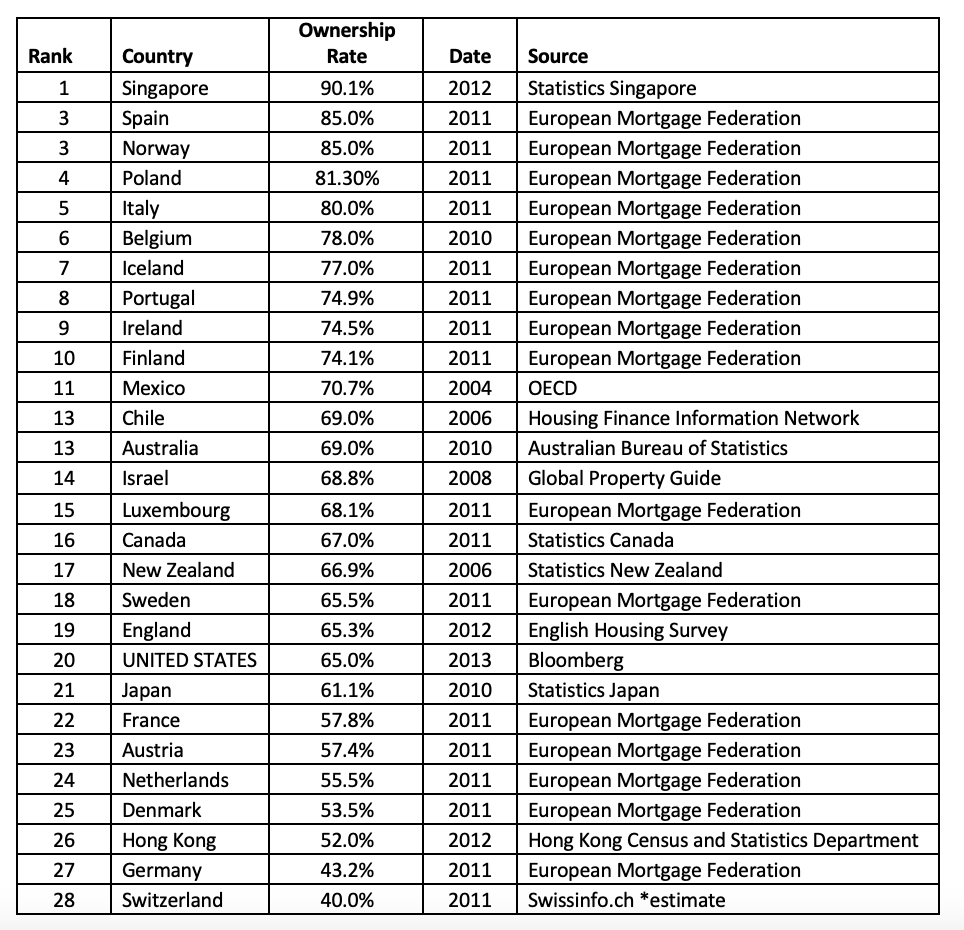
Source: AEI research
How do financial professionals in other countries view the U.S. housing finance sector?
More than a decade ago, when Fannie and Freddie were still riding high, and Fannie in particular was a greatly feared bully boy whom both Washington politicians and Wall Street bankers were afraid to cross or offend, I presented the GSE-centric U.S. housing finance system to the Association of Danish Mortgage Banks in Copenhagen. When I was done, the CEO of one of their principal mortgage lenders memorably summed things up:
“In Denmark we always say that we are the socialists and America is the land of free enterprise. Now I see that when it comes to mortgage finance, it is the opposite!”
He was so right. But now, with Fannie and Freddie continuing to be guaranteed by the U.S. Treasury, able to run with zero capital and infinite leverage, being granted huge loopholes by the Consumer Financial Protection Bureau, and being heavily subsidized by the Federal Reserve’s buying up their MBS, they have a bigger market share and more monopoly power than before. The American housing finance sector is more socialized than ever.
Here’s a view from Britain, where a senior financial official said recently:
“We don’t want a government guaranteed housing finance market like the United States have.”
They don’t want what we have—and we don’t want it either. How do we conceptualize the range of alternate possibilities?
Every housing finance system in the world must address two fundamental questions. The first is how to match the nature of the mortgage loan with an appropriate funding source, so you are not lending long and borrowing short. Different approaches distribute the interest rate risk among the parties involved—lenders, investors, borrowers, governments, taxpayers--in various ways.
Basic sustainable variations observed in different countries include variable rate mortgages funded with short-term deposits; medium term fixed-rate mortgages funded with medium-term fixed rate deposits or bonds; long-term fixed rate mortgages funded with long-term fixed rate bonds or covered bonds. In general, to soundly fund long-term fixed-rate mortgages, you have to have access to the bond market. In an advanced financial system, it does not require a GSE to do this.
The classic example of not achieving the needed interest rate match was the collapse of the American savings and loan industry in the 1980s. What broke the savings and loans was the combination of their interest rate mismatch with the soaring interest rates of the great inflation created by the Federal Reserve in the 1970s. While the lenders were crushed, borrowers who had old 30-year fixed rate mortgages in this period of rising interest rates and inflating house prices did very well.
In contrast, the 30-year fixed rate mortgage was terrible for great numbers of borrowers in the U.S. crisis of the 2000s. With the floating rate mortgage system of England, the rapid fall of interest rates in the housing crisis was automatically passed on to the borrowers in the form of lower payments, which helped contain the crisis. American borrowers faced with falling interest rates and house price deflation, on the other hand, were often locked in to high payments and punished by their 30-year fixed rate mortgages, which thereby made the housing bust worse in this country.
The second fundamental question of housing finance systems is who will bear the credit risk. In most countries, the lender retains the credit risk, which is undoubtedly the superior alignment of incentives. With covered bonds, which are used in many countries, you can simultaneously achieve fixed-rate funding while keeping the lender fully on the hook for the credit performance of the mortgage loans being funded.
The American GSE approach (and also that of private MBS) systematically separates the credit risk from the lender-- so you divest the credit risk of the loans you make to your own customers. This was and is a distinct outlier among countries. It had disastrous results, needless to say.
The most perfect conceptual solution to the two fundamental questions of housing finance, which functions very well in practice in its national setting, is the housing finance system of Denmark. This system has been justifiably admired by many observers. It operates in a small country, but represents big basic ideas.
The Danish mortgage approach to interest rate risk in its funding market is explicitly governed by what it calls the “matching principle.” This means that the interest rate and prepayment characteristics of the mortgage loans being funded are passed on entirely to the investor in Danish mortgage covered bonds. This allows long-term fixed rate mortgages, as well as variable rate mortgages.
At the same time, the entire credit risk is retained by the mortgage bank lenders. They have 100% “skin in the game” for credit risk, in exchange for an annual fee, thus insuring alignment of incentives for credit performance. Deficiency judgments, if foreclosure on a house does not cover the mortgage debt, are actively pursued. In other words, mortgage loans are always made with recourse to the borrower’s other income and assets. This is true in most countries. The U.S. state laws or practices of non-recourse mortgage lending are again a distinct outlier.
The fundamentals of the Danish mortgage system go back over 200 years, to the 1790s. There are no GSEs. The Danish system can deliver long-term fixed rate loans of up to 30 years with a prepayment option. This is a private housing finance system build on quite robust principles, which claims that no mortgage bond holder has suffered a credit loss in over two centuries. Denmark can and in the last decade did have a housing price bubble and bust, but the housing finance sector performed much better through it than did ours, and its covered bonds were sold throughout 2007-09. We should note that the Danish system generates a home ownership rate of 54%, on the low side.
Another interesting case of the splitting of bond market funding and credit risk is that of Cagamas, or the National Mortgage Company of Malaysia. Cagamas buys mortgage loans from lenders, and then issues bonds to finance them, but the mortgage purchases are with full recourse to the lender, so the lender retains 100% of the credit risk and the alignment of incentives.
Cagamas is 80% owned by the banks and 20% by the Malaysian central bank, so it is a GSE, but not a Fannie and Freddie-style GSE. Instead it functionally resembles the Federal Home Loan Banks (FHLBs). FHLBs provide bond market funding for mortgages through advances to banks, but the banks retain all the credit risk. FHLBs also buy mortgages, but only when the bank credit enhances the mortgages it has made. (It may be of interest that of all sizeable American GSEs, considering Fannie, Freddie and the Farm Credit Banks, the FHLBs are the only ones which have never gone broke.)
A very stable, sound, and very conservative housing finance market is that of Germany. Some of its banks got into trouble in this cycle by buying U.S. mortgage securities, but their domestic mortgage market did not experience either a housing price boom-bust or a mortgage credit crisis. The problem is that the German system generates a very low home ownership rate, only 43%--as well as a relatively late age at which people are on average able to buy houses. I imagine that neither of these would be politically acceptable in the U.S.
Nevertheless, there are two German ideas worthy of study. One is the German version of mortgage covered bonds (“Pfandbriefe”). With a statutory basis more than one hundred years old (and, it is claimed, a history going back to Frederick the Great in the 18th century), these covered bonds form and large and relatively stable source of bond-based mortgage funding with no GSE. The issuing bank retains all the credit risk of the mortgage loans. Mortgage loans funded with these covered bonds have a maximum LTV of 60%.
Many people have proposed, and I agree, that the U.S. should introduce covered bonds without a government guaranty as a mortgage funding alternative, as part of escaping from the mortgage market’s subservience to GSEs.
A second German housing finance idea worth considering is their emphasizing the role of savings as an essential part of sound housing finance. The German building and savings banks (“Bausparkassen”) continue to practice the savings contract, which was once also common in this country. By such a contract, the borrower commits to regular savings as part of qualifying for a mortgage loan. This is, in my opinion, a very old-fashioned, very good idea.
Canada makes a pertinent comparison for the U.S., both countries being advanced, stable, financially sophisticated and North American. The Canadian housing finance system, like most in the world, has no GSEs. It is primarily funded on the balance sheets of banks, although Canadian banks are also becoming issuers of covered bonds under new legislation, and it came through the crisis of 2007-09 in much better shape than did we did. Mortgage lending is more conservative and creditor-friendly, and the Canadian system currently produces a higher home ownership rate of 67%.
Although it has no GSEs, Canada does have a very important government body to promote housing finance, which plays a substantial role in the mortgage sector. This is the Canada Mortgage and Housing Corporation (CMHC). Its principal activity is insuring (i.e. guaranteeing) mortgage loans—and it guarantees approximately half of all Canadian mortgages. This is about the same proportion as the combined Fannie and Freddie have of outstanding the U.S. mortgage credit exposure.
But in contrast to the game the U.S. played of pretending that Fannie and Freddie were “private,” and that the government exposure was not really there (it was only “implicit”), CMHC’s status is refreshingly clear and honest. It is a 100% government-owned and controlled corporation. It has an explicit guaranty from the government. It also provides housing subsidies which are on budget and must be appropriated by Parliament. So Canada, while having this large government intervention in the mortgage market, is definitely superior to us in candor and clarity about it.
This exemplifies what I believe to be a core principle: You can be a private company. Or you can be part of the government. But you should never be allowed to pretend you are both. In other words, Fannie and Freddie should cease to be GSEs. Considering the international anomaly and the disastrous government experiment they represent, we should all be able to agree on this.
Thank you again for the opportunity to share these views.

Boom and Bust: Financial Cycles and Human Prosperity (Values and Capitalism)
Published by American Enterprise Institute (AEI) Press. Order here.
While the recent economic crisis was a painful period for many Americans, the panic surrounding the downturn was fueled by an incomplete understanding of economic history. Economic hysteria made for riveting journalism and effective political theater, but the politicians and members of the media who declared that America was in the midst of the greatest financial calamity since the Great Depression were as wrong and misguided as the expansionists of the Roosevelt era. In reality the cyclical nature of market economies is as old as the markets themselves. In a free market system, financial downturns inevitably accompany economic prosperity-but the overall trend is upward progress in living standards and national wealth. While it is helpful to understand what caused the recent crisis, the more important questions to consider are ‘What makes the ‘boom and bust’ cycle so predictable?’ and ‘What are the ethical responsibilities of the citizens of a free market economy?’ In Boom and Bust: Financial Cycles and Human Prosperity, Alex J. Pollock argues that while economic downturns can be frightening and difficult, people living in free market economies enjoy greater health, better access to basic necessities, better education, work less arduous jobs, and have more choices and wider horizons than people at any other point in history. This wonderful reality would not exist in the absence of financial cycles. This book explains why.
The Subprime Bust and the One-Page Mortgage Disclosure
Testimony of
Alex J. Pollock
Resident Fellow
American Enterprise Institute
Washington, DC
To the Senate Banking and Financial Institutions Committee
State of Michigan
The Subprime Bust and the One-Page Mortgage Disclosure
November 28, 2007
Mr. Chairman, Vice Chairmen Sanborn and Hunter, and members of the Committee, thank you for the opportunity to be here today. I am Alex Pollock, a Resident Fellow at the American Enterprise Institute, and these are my personal views. Before joining AEI, I spent 35 years in banking, including 12 years as President and CEO of the Federal Home Loan Bank of Chicago, and am a Past President of the International Union for Housing Finance. I have both experienced and studied many credit cycles, of which the housing and subprime mortgage boom and bust is the latest example. Before all that, I grew up in Michigan, in the City of Detroit, graduating from Redford High School.
The deflation of the housing bubble and the subprime mortgage bust is, as everyone now knows, the biggest financial issue of the year, and nowhere more so than in Michigan. I will address two aspects of this issue: understanding the fundamental pattern in which we are caught; and making sure future borrowers are better equipped to protect themselves than those of today.
The severe problems of all the industries involved in housing and mortgage finance, as well as of a great many mortgage borrowers, can best be understood as the deflation of a classic asset bubble. The boom is always marked by rapid and unsustainable asset price increases, inducing and fueled by a credit overexpansion marked by unwise optimism, which leads to unwise credit decisions on the part of both lenders and borrowers. The inevitable bust follows with defaults, losses and a credit contraction. We are in the midst, and by no means near the end, of the contraction.
American residential mortgages represent the largest credit market in the world, and residential real estate is a huge asset class and component of household wealth. The negative effects of the deflating bubble on macroeconomic growth are sizeable and significant—some forecasters believe negative enough to cause a recession, which will in turn worsen the mortgage credit problems.
Among possible political responses are temporary programs to bridge and partially offset the impact of the bust, and to reduce the risk of a housing sector debt deflation or self-reinforcing downward spiral.
We can also take long term steps to fundamentally improve the functioning of the mortgage market. Today I will focus on a very simple but powerful proposal, which has been introduced into both houses of the U.S. Congress, passed as a local ordinance in by the Washington, DC Council, and could be used at a state level: a one-page mortgage disclosure which tells borrowers what they really need to know about their mortgage loan in a clear and straightforward way. This would both better equip borrowers to protect themselves and make the mortgage market more efficient.
1. Understanding the Fundamental Pattern
Needless to say, the unsustainable expansion of subprime mortgage credit and the great American house price inflation of the new 21st century are both over. Former enthusiasm at rising home ownership rates and financial innovation (now a little hard to remember) have been replaced by an international credit market panic, layoffs, closing or bankruptcy of more than a hundred subprime lenders, still accelerating delinquencies and foreclosures, a deep recession in the homebuilding industry, tens of billions of dollars of announced losses by financial firms, tightening or disappearing liquidity, increasingly pessimistic forecasts, and of course, recriminations.
A few months ago, typical estimates of the credit losses involved were about $100 billion. Then they grew to $150 billion, a number Federal Reserve Chairman Bernanke recently cited, and which I believe to be a reasonable estimate. Other forecasts have the total losses at $250 billion, $300 billion, and even $400 billion—well, uncertainty is high. Those are the losses for the lenders; for the borrowers, as you all know only too well, rising foreclosures are an obvious social and political issue.
All these elements display the classic patterns of recurring credit overexpansions and their aftermath, as colorfully discussed by students of financial cycles like Charles Kindleberger, Walter Bagehot and Hyman Minsky. Such expansions are always based on optimism and the euphoric belief in the ever-rising price of some asset class—in this case, houses and condominiums. This appears to offer a surefire way for lenders, investors, borrowers and speculators to make money, and indeed they do, for a while. As long as prices always rise, everyone can be a winner.
A good example of such thinking was the 2005 book by an expert housing economist entitled, Are You Missing the Real Estate Boom? Why the Boom Will Not Bust and Why Property Values Will Continue to Climb Through the Rest of the Decade.
This time, we had several years of remarkably rising house prices—the greatest U.S. house price inflation ever, according to Professor Robert Shiller of Yale University. The total value of residential real estate about doubled between 1999 and 2006, increasing by $10 trillion. The great price inflation stimulated the lenders, the investors, the borrowers and the speculators. If the price of an asset is always rising, the risk of loans seems less and less, even as the risk is in fact increasing, and more leverage always seems better.
A key point is that in the boom, many people experience financial success. This so-far successful speculation is extrapolated. Subprime borrowers could get loans to buy houses they would otherwise be unable to and benefit from subsequent price appreciation. A borrower who took out a very risky 100% LTV, adjustable rate mortgage with a teaser rate to buy a house which subsequently appreciated 30% or 40% now had substantial equity and a successful outcome as a result of taking risk.
Should people be able to take such risks if they want to? Yes, but they should have a clear idea of what they’re doing.
Of course, we know what always happens sooner or later: the increased risk comes home to roost, prices fall, and there is a hangover of defaults, failures, dispossession of unwise or unlucky borrowers, revelations of fraud and swindles, and the search for the guilty. You would think we would learn, but we don’t. Then come late-cycle political reactions.
With regard to the last point, since 1970 we have had the Emergency Home Finance Act of 1970, the Emergency Housing Act of 1975, the Emergency Housing Assistance Act of 1983, and the Emergency Housing Assistance Act of 1988. (I do not count the Hurricane Katrina Emergency Housing Act of 2005, a special case.) Kindleberger estimated that over the centuries, financial crises recur about once a decade on average, and so apparently do emergency housing acts. It seems probable to me that, given the current problems, this fall or winter will bring an emergency housing act of 2007 or 2008. Indeed, the “Emergency Home Ownership and Mortgage Equity Protection Act of 2007” has been introduced in to the Congress.
A year ago, it was common to say that while house prices would periodically fall on a regional basis, they could not on a national basis, because that had not happened in the large U.S. market since the Great Depression. Well, now house prices are falling on a national basis, as measured by the S&P/Case-Shiller national index.
House sales have dropped steeply, and for-sale inventories of new and existing houses and condominiums are high. At the same time, rising mortgage delinquencies and defaults, along with the collapse of funding through securitization, have caused lenders to drop subprime products or exit the business altogether and generally raise credit standards. The Chairman of Countrywide Credit has announced, “We are out of the subprime business.” Sharply reduced mortgage credit availability reduces housing demand.
With excess supply and falling demand, it is not difficult to arrive at a forecast of further drops in house prices. The recent Goldman Sachs housing forecast, pointing out “substantial excess supply” and that “credit is being rationed,” projects that average house prices will fall 7% a year through 2008. This is along with projected falling home sales and housing starts.
Professor Shiller has suggested that this cycle could see “more than a 15% real drop in national home price indicies.” Certainly a return to long term trends in house values would imply a significant adjustment.
The Bank of America’s current forecast has nominal house prices falling 15% (real prices over 30%) over four years, having started this year and not bottoming until 2011.
Thus the “HPA” or house price appreciation of credit models has now become “HPD”—house price depreciation.
The June 30, 2007 National Delinquency Survey of the Mortgage Bankers Association reports a total of 1,090,300 seriously delinquent mortgages. Serious delinquency means loans 90 days or more past due plus loans in foreclosure. Of the total, 575,200 are subprime loans. Thus subprime mortgages, which represent about 14% of mortgage loans, are 53% of serious delinquencies.
The survey reports 618,900 loans in foreclosure, of which 342,500 or 55% are subprime.
The ratio of subprime loans in foreclosure peaked in 2002 at about 9%, compared to its June 30 level of 5.5%. Seriously delinquent subprime loans peaked during 2002 at 11.9%, compared to 9.3%. These second-quarter ratios are not as bad as five years ago, but they are still rising.
A systematic regularity of mortgage finance is that adjustable rate loans have higher defaults and losses than fixed rate loans within each quality class. Thus we may array the June 30, 2007 serious delinquency ratios as follows:
Prime fixed 0.67% Prime ARMs 2.02%
FHA fixed 4.76% FHA ARMs 6.95%
Subprime fixed 5.84% Subprime ARMs 12.40%
The particular problem of subprime ARMs leaps out of the numbers. The total range is remarkable: the subprime ARM serious delinquency ratio is over 18 times that of prime fixed rate loans.
Mortgage finance has some reliable systematic risk factors. The mortgage boom had all the systemic risk factors operating together:
-Subprime loans have higher defaults and losses than prime loans.
-Adjustable rate loans of all kinds have higher defaults and losses than fixed rate loans.
-High loan-to-value (LTV) loans have higher defaults and losses than low LTV loans.
-Low documentation loans have higher defaults and losses than standard documentation loans.
-Loans for investment properties have higher defaults than loans for owner-occupied houses.
The subprime mortgage lenders knew all these statements were true, but the risk acceleration of the boom outstripped the expectations of their models. As Moore’s Law of Finance states, “The model works until it doesn’t.”
A central problem is that during the boom the subprime market got very much larger than it used to be. In the years of credit overexpansion, it grew to $1.3 trillion in outstanding loans, up over 8 times from its $150 billion in 2000. So the financial and political impact of the subprime level of delinquency and foreclosure is much greater than in earlier years.
But for Michigan, it is not only a subprime problem. Michigan’s serious delinquency rate for all mortgage loans is 4.61%, almost twice the national average of 2.47%. This reflects the employment problems of the domestic auto industry, on top of the housing deflation, as is also the case for the neighboring high-delinquency states of Ohio and Indiana.
Michigan’s serious delinquency rates are more or less double the national average in all mortgage loan categories, with the June 30 comparisons as follows:
Michigan U.S. Michigan/U.S.
Subprime ARMs 21.08% 12.40% 1.7X
FHA ARMs 13.78% 6.95% 2X
FHA fixed rate 10.75% 4.76% 2.3X
Subprime fixed rate 9.47% 5.84% 1.6X
Prime ARMs 4.65% 2.02% 2.3X
Prime fixed rate 1.34% 0.67% 2X
For the country as a whole, fixed rate FHA loans have a serious delinquency rate similar to that for fixed rate subprime loans. This is also true for Michigan, which also has the highest FHA serious delinquency rate of any state.
The American residential mortgage market has about $10 trillion in outstanding loans. Residential real estate is a huge asset class, with an aggregate value of about $21 trillion, and is of course the single largest component of the wealth of most households.
A 15% average house price decline would mean a more than $3 trillion loss of wealth for U.S. households, which would be especially painful for those who are highly leveraged. It would certainly put a crimp in getting cash to spend through cash-out refinancing and home equity loans.
The deflation of a bubble centered on such large stocks of debt and assets always causes serious macroeconomic drag. Housing busts have typically translated into recessions. It goes without saying that the current bust has already been and will continue to be a significant negative for economic growth. Moody’s recently forecast that the “unexpectedly steep and persistent downturn” in the mortgage and housing sector would last until 2009.
At an AEI conference last March, my colleague Desmond Lachman predicted that the economic impact of the housing problems would be much worse than was generally being said at the time, including what he considered the overoptimistic view of the Federal Reserve, and that they would become a major political issue. These were certainly good calls.
Large losses from the deflating housing and mortgage bubble have already happened and must unavoidably work their way through the financial and economic system. Reductions in household wealth and tighter credit constraints on consumers might be enough to turn consumption growth negative and cause a recession.
This would be, my colleague John Makin has suggested, “the price we pay” for the housing bubble.
2. A Simple Proposal for Fundamental Improvement: The One-Page Form
The mortgage market, like all financial markets, is constantly experimenting with how much risk there should be. The subprime mortgage boom obviously overshot on risk creation; lenders, borrowers and the economy are now paying the price. “Risk,” as an old boss of mine used to say, “is the price you never thought you’d have to pay.”
Should ordinary people be free to take a risk in order to own a home, if they want to? Yes, provided they understand what they are getting into. (This is a pretty modest risk, to say the least, compared to those our immigrant and pioneer ancestors took, such as my great-grandfather, heading out to his homesteaded farm in Michigan.)
Should lenders be able to make risky loans to people with poor credit records, if they want to? Yes, provided they tell borrowers the truth about what the loan obligation involves in a straightforward, clear way.
A market economy based on voluntary exchange and contracts requires that the parties understand the contracts they are entering into. A good mortgage finance system requires that the borrowers understand how the loan will work and how much of their income it will demand.
Nothing is more clear than that the current American mortgage system does not achieve this. Rather it provides an intimidating experience of being overwhelmed and befuddled by a huge stack of documents in confusing language and small type presented to us for signature at a mortgage closing. This complexity results from legal and compliance requirements; ironically, past regulatory attempts to insure full disclosure have made the problem worse. This is because they attempt full, rather than relevant, disclosure.
Trying to describe 100% of the details in legalese and bureaucratese results in essentially zero actual information transfer to the borrower. The FTC recently completed a very instructive study of standard mortgage loan disclosure documents, concluding that “both prime and subprime borrowers failed to understand key loan terms.”
Among the remarkable specifics, they found that:
“About a third could not identify the interest rate”
“Half could not correctly identify the loan amount”
“Two-thirds did not recognize that they would be charged a prepayment penalty” and
“Nearly nine-tenths could not identify the total amount of up-front charges.”
As the events of the current bust have demonstrated, this problem is especially important in, though by no means limited to, the subprime mortgage market.
To help address these shortcomings of the mortgage market which are evident, I believe a new, superior disclosure approach is needed. The key is to realize that complex, lengthy statements in regulatoryese and legalese do not achieve the goal. Moreover, the simple, clear disclosure should be focused on the financial impact on the borrower, not on the financial instruments.
The superior strategy is to equip borrowers to protect themselves by requiring short, simple and clear disclosures of the key mortgage loan terms and their relation to household income.
Thus I propose there should be a required one-page form which gives the essentials of the loan and its monthly cost, which must be given to every mortgage borrower well before closing.
A good mortgage lender wants a borrower who understands how the loan will work, including any possible future interest rate increases and prepayment penalties. The total monthly obligation needs to be put clearly in the context of the borrower’s income.
To have informed borrowers who can better protect themselves, the key information must be simply stated and clear, in regular-sized type, and presented from the perspective of what commitments the borrower is making and what that means relative to household income. The borrowers can then “underwrite themselves” for the loan. They have a natural incentive to do so—and can if they have the relevant intelligible, practical information.
The one-page form should include key underwriting concepts, including the borrower’s income and housing expense ratio, as well as principal loan terms. The “housing expense ratio” means the sum of the monthly interest payment, principal payment, property tax, and house insurance premium, expressed as a percent of the borrower’s monthly income. This should be shown for both the initial interest rate and the fully-indexed interest rate. In typical types of subprime loans, as has become so painfully obvious, the fully-indexed expense ratio can be a remarkably larger burden than the initial or “teaser” rate suggests.
I have called the one-page form, “Basic Facts About Your Mortgage Loan.” With it are brief explanations of the mortgage vocabulary and some avuncular advice for borrowers. Borrowers should receive it from the lender in time to ensure understanding and the ability to make a decision to seek alternatives. A copy of the proposed form accompanies this testimony, as well as a copy of a Washington Post editorial recommending it.
I believe mandatory use of this form would help achieve the required clarity, make borrowers better able to protect themselves by understanding what the mortgage really means to them, and at the same time would promote a more efficient mortgage finance system. This seems to me a completely bipartisan idea, which should be implemented as a fundamental reform, whatever else is done or not done.
Thank you again for the opportunity to share these views.
Attachments:
The One-Page Form (“Basic Facts About Your Mortgage Loan”)
Washington Post editorial (“The Next Financial Crisis—How to Avoid It”)


Hearing on Systemic Risk and Regulation
Testimony of
Alex J. Pollock
Resident Fellow
American Enterprise Institute
To the Committee on Financial Services
United States House of Representatives
Hearing on Systemic Risk and Regulation
October 2, 2007
Mr. Chairman, Ranking Member Bachus and members of the Committee, thank you for the opportunity to be here today. I am Alex Pollock, a Resident Fellow at the American Enterprise Institute, and these are my personal views. Before joining AEI, I spent 35 years in banking, including twelve years as President and CEO of the Federal Home Loan Bank of Chicago. I am a Past President of the International Union for Housing Finance and a director of three companies in financial businesses.
My career has included many credit cycles which involved issues of systemic risk, from the credit crunch of 1969, the commercial paper panic of 1970, and the real estate investment trust collapse of 1975 (in which the entire commercial banking system was thought by some to be insolvent) to the current example of the credit panic triggered by the ongoing subprime mortgage and housing bust, and a number of others in between. Moreover, I have studied the long history of such financial events and their recurring patterns.
Booms and Busts in Context
To begin with, let me try to put the issues of financial booms and busts and the related question of systemic risk in context.
The fundamental principle is that long term growth and the greatest economic well being for ordinary people can only be created by market innovation and experimentation. Markets for goods and services must be accompanied by markets in financial instruments, which by definition place a current price on future, thus inherently uncertain, events. This much is obvious but easy to forget when addressing the results of a bust with the benefit of hindsight, when it seems like you would have to stupid to make the mistakes that smart people actually made.
Dealing with putting prices on the inherently uncertain future, all financial markets are constantly experimenting with how much risk there should be, how risks are distributed, what the price of risk-bearing should be, and how risk trades off with financial success or failure. Should individuals and institutions be free to take financial risks if they want to? Yes, they should.
In the boom, many people succeed, just as many people succeeded for a long time in the subprime mortgage and housing boom. This success gets extrapolated, supports optimism and makes lenders and investors, including private pools of capital, confident. Lender and investor confidence tends to the underestimation of risks, in particular, the risk that the price of the asset in favor, most recently houses, could fall or fall very much; and underestimation of the risk that if prices fall, especially in a leveraged sector, asset and credit markets could become illiquid.
In my opinion, the principles stated by the President’s Working Group for private pools of capital are professional and sensible. But even if everybody followed them, we would not avoid the inevitable times of financial turbulence.
We know for certain that markets will create long term growth and also cyclical booms and busts, but just what or when the outcome of a particular innovation will be cannot be known in advance. It can only be discovered by running the market experiment, as so brilliantly discussed in Friedrich Hayek’s “Competition as a Discovery Procedure.”
How hard it is to outguess this discovery procedure is shown by the fact that a mere three months ago, the financial and economic world was constantly treated to statements by very intelligent and well-informed people that there was “abundant liquidity” or even a “flood of liquidity,” which would guarantee a firm market bid for risky assets and narrow spreads. Then we were suddenly confronted with a lack of bids, nonfunctioning markets and the “evaporation of liquidity.”
Likewise, some very intelligent and well-informed people said, up until August, that the subprime mortgage bust would be “contained” and not cause wider financial or economic problems. Now we have had a subprime-induced credit panic and an ongoing credit crunch, with falling house prices, but the stock market has gone back up to near its high. How do we interpret that?
A fundamental point is that markets are recursive. Whatever opinions influence buying and selling and hedging, whatever models of financial behavior are relied on, whatever is done to regulate them, are all fed back into the system of interactions and change behavior in unpredictable ways. Thus models of financial behavior, themselves changing the market, tend to become less effective or obsolete, as did subprime credit models.
Regulations likewise change financial behavior, are arbitraged, and may end up producing the opposite of their intent. This is why regardless of what any regulator or legislator may do, markets will always create however much risk they want. Then when the bust has begun, regulatory actions to reduce or control risk may turn out to be procyclical, reinforcing the downward momentum.
Models
To successfully avoid booms and busts, regulatory operations or market actors would have to know the future. They often attempt to do so through creating models.
Of course, there is always a difference between financial models, however mathematically refined, and financial reality. This is so whether the models are those of Wall Street “rocket scientists” structuring securities, credit rating agencies, hedge funds or other private pools of capital, sophisticated institutions, the Federal Reserve or other regulators, or investment analysts. Finance cannot in principle be turned into physics.
John Maynard Keynes memorably observed that a prudent banker is one who goes broke when everybody else goes broke. One way to do this is to use models with the same assumptions that everybody else has. Then you can be confident when everybody else is confident and afraid when everybody else is afraid. (We can be skeptical of the models approach of Basel II in this respect.)
Once a Decade, On Average
The classic patterns of booms based on credit overexpansions and their following busts are colorfully discussed by such students of financial cycles as Charles Kindleberger, Walter Bagehot and Hyman Minsky.
Kindleberger, surveying several centuries of financial history, observed that financial crises and scandals occur, on average, about once every ten years. This matches my own experience. Every bust is followed by reforms, but the next bust arrives nonetheless. Still the trend of market innovation and long term growth continues.
The increased risk accumulated in credit overexpansions ultimately comes home to roost and prices of the favored asset fall. There is a hangover of defaults, failures, dispossession of unwise or unlucky borrowers, revelations of frauds and swindles (always), and then the search for the guilty. There is a sharp restriction of credit. For example, the chief executive of Countrywide recently announced, “We are out of the subprime business.”
There is a generalized retreat from risky assets, and a new danger arises: fire sales of assets turning into a debt deflation and the ruin of the financial system—systemic risk has arrived. Our students of financial cycles all support government intervention to stabilize the downward momentum. This is the correct answer as long as it is temporary.
To come to the current situation, it is evident that the present combination of the excess inventory of houses and condominiums, with the rapid restriction of mortgage credit—in other words, increased supply plus falling demand, equals a trend of falling house prices. The models used to analyze, rate and price subprime securitizations include as a key factor house price appreciation (“HPA” in the trade jargon). Now that we have house price depreciation, what will happen if prices fall much more and much more broadly than the models, the investors, the lenders and the regulators thought they could?
Unfortunately, a vicious cycle of falling house prices, more defaults, further credit tightening, less demand, further falls in prices, more defaults, and so on, is possible for a while, though of course not forever. Financial market result: Fear.
The fear is increased by great uncertainty about the value of subprime securities if no one wants to buy them anymore. What are they worth as assets to an investor, notably a leveraged investor? What are they worth as collateral to a lender—especially a very risk-averse repo dealer or commercial paper buyer?
Greater disclosure and transparency are reasonably suggested, although financial accounting, at least, is never truly “transparent.”
For example, what does “value” even mean when there are few or no buyers? How can assets be marked to market if there is no active market? Should everybody’s portfolio be marked to fire sale prices, or instead to some estimate of intrinsic value? Who is actually broke and who isn’t? The answers to these classic questions of the bust are never clear, except in retrospect.
Liquidity
As Bagehot wrote, “Every great crisis reveals the excessive speculations of many houses which no one before suspected.” So has our current bust, and these unpleasant surprises reinforce the uncertainty make about who is broke and who isn’t (perhaps including yourself). With this uncertainty and personal as well as institutional risk, everyone becomes conservative at once. When all investors and lenders, institutionally and personally, try quite logically to protect themselves by avoiding risk, the result is to make liquidity disappear and to put the whole at risk. Note that possibility of regulatory or political punishment arising from the search for the guilty will increase the risk aversion.
In other words, it is belated risk aversion which creates systemic risk. To understand why this can happen, we have to see that “liquidity” is not a substance which can “flow,” be a “flood,” “slosh around,” or be “pumped” somewhere, to use a number of misleading expressions.
In fact, liquidity is a figure of speech. It is verbal shorthand for the following situation:
-A is ready and able to buy an asset from B on short notice
-At a price B considers reasonable
-Which usually means C has to be willing to lend money to A
-And if C is a dealer, both A and C have to believe the asset could readily be sold to D
-Which means A and C believe there is an E willing to lend money to D.
Good times, a long period of profits, and an expansionary economy induce financial actors and observers to take this situation, “liquidity,” too much for granted, so liquidity comes to be thought of as how much you can borrow. When the crisis comes, it is found to be about what happens when you can’t borrow, except from some government instrumentality.
At this point we have arrived at why central banks exist. The power of the government, with its ability to compel, borrow, tax, print money, and credibly guarantee the payment of claims, can intervene to break the everybody-stops-taking-risk-at-once psychology of systemic risk.
The key is to assure that this intervention is temporary, as are credit panics by nature. As historically recent examples of government interventions in housing busts, since 1970 we have had the Emergency Home Finance Act of 1970, the Emergency Housing Act of 1975, the Emergency Housing Assistance Act of 1983, and the Emergency Housing Assistance Act of 1988. (I do not count the Hurricane Katrina Emergency Housing Act of 2005, a special case.) This is in line with Kindleberger’s estimate of about once a decade on average, and an emergency housing act of 2007 would fit the pattern.
The liquidity crunch won’t last forever. Large losses will be taken, the market get used to the idea, who is broke and who isn’t sorted out, failures reorganized, risks reassessed, models rewritten, and revised clearing prices discovered. A, B, C, D and E will get back into business trading and lending to each other again.
Liquidity will return reasonably quickly for markets in prime instruments. One long time observer of finance, whose insights I value, has predicted that “the panic about credit markets will be a memory by Thanksgiving.”
I believe this is probably right; however, the severe problems with subprime mortgages and securities made out of them, related defaults and foreclosures, and falling house prices will continue long past then. They will continue to cause macroeconomic drag and financial difficulties, but the moment of systemic panic will have passed.
The “Cincinnatian Doctrine”
In conclusion, my view is that it is not possible to design society, no matter what regulatory systems may be implemented, to avoid financial booms and busts and their resulting risk of systemic panics. We do need temporary interventions of the government periodically, when the financial system is threatened by a downward spiraling debt deflation. In other words, booms and busts are endemic to market economies with financial markets in which people are free to take risks and engage in borrowing against the uncertain future. They are a price well worth paying in return for the innovation and growth only such markets can create.
In normal times, that is, about 90% of the time, we predominately want the economic efficiency, innovation, productivity and the resulting well-being for ordinary people produced by competitive markets. But when the financial system hits its inevitable periodic crises, about 10% of the time, the intervention of the government is often necessary. This intervention should be temporary. If prolonged, it will tend to cartels, bureaucracy, less innovation, and less growth. In the extreme, of course, it becomes socialist stagnation.
Thus I suggest a 90%-10% policy mix. I have elsewhere explored this idea as the “Cincinnatian Doctrine.”
In the wake of every bust, various plans are put in place to prevent all future ones, but the next bust arrives in about ten years anyway. Such plans suffer from the assumption that financial group behavior is mechanistic and can be addressed by designing mechanisms. In fact, it is organic, creative, recursive and emergent. That is the source of its strength in creating wealth, also of its weakness in getting periodically carried away. I do not believe any regulatory structures can alter these fundamental characteristics.
Thank you again for the opportunity to share these views.
Hearing on Bank Mergers and Subprime Mortgage Credit Problems
From Testimony of
Alex J. Pollock
Resident Fellow
American Enterprise Institute
To the Subcommittee on Domestic Policy Committee on Oversight and Government Reform
United States House of Representatives
Hearing on Bank Mergers and Subprime Mortgage Credit Problems
Cleveland, Ohio May 21, 2007
***
The One-Page Mortgage Disclosure Proposal
When considering borrowers in financial trouble, whether from unwise borrowing, not having understood the loan, or even induced into loans by misrepresentation, there is a natural political reaction to try to protect them through credit regulation.
I believe a superior strategy is to equip borrowers to protect themselves by requiring short, simple and clear disclosures of the key mortgage loan terms and their relation to household income. The borrowers can then “underwrite themselves.” They have the natural incentive to do so—we need to add intelligible, practical information.
To help address the shortcomings of the subprime market which have become evident, I believe a new, superior disclosure approach is needed, whether or not we do anything else. The key is to realize that complex, lengthy statements in regulatoryese and legalese do not achieve the goal. Moreover, the simple, clear disclosure should be focused on the financial impact on the borrower, not on the financial instruments.
Thus I propose there should be a required one-page form which gives the essentials of the loan and its monthly cost, which must be given to every mortgage borrower three days before closing. 2
A good mortgage lender wants a borrower who understands how the loan will work, including any possible future interest rate increases and prepayment penalties. The total monthly obligation needs to be put clearly in the context of the borrower’s income.
Current American mortgage loan documents certainly do not achieve this. Most of us have had the experience of being overwhelmed and befuddled by the huge stack of documents full of confusing language in small print presented to us for signature at a mortgage closing. The complexity results from legal and compliance requirements. Ironically, past regulatory attempts to insure full disclosure have made the problem worse. That is because they attempt full, rather than relevant, disclosure.
To achieve an informed borrower, the key information must be simply stated and clear, in regular-sized type: 90% of the relevant information which is clear and understandable is far better than 100% of the details which are complex and hard to read. Trying to describe the details in specific legal and bureaucratic terms results in essentially zero information transfer to the borrower.
The one-page form should include key underwriting concepts, including the borrower’s income and housing expense ratio, as well as principal loan terms. The “housing expense ratio” means the sum of the monthly interest payment, principal payment, property tax, and house insurance premium, expressed as a percent of the borrower’s monthly income. This should be shown for both the initial interest rate and the fully-indexed interest rate. In typical types of subprime loans, the fully-indexed expense ratio can be a remarkably larger burden than the initial or “teaser” rate suggests.
The proposed one-page “Basic Facts About Your Mortgage Loan” form, with accompanying common sense explanations and avuncular advice, is Attachment 1.
One of the deans of mortgage journalists has written of how the one-page proposal is distinct from previous regulations and simplification attempts. His article is also attached.
Whatever else is done or not done, I believe the one-page disclosure would be an important step forward for America’s and Ohio’s mortgage borrowers and housing finance system.
How to Improve the Credit Rating Agency Sector
Testimony of
Alex J. Pollock
Resident Fellow
American Enterprise Institute
To the Committee on Banking, Housing and Urban Affairs
United States Senate
Hearing on Assessing the Current Oversight and Operations of Credit Rating Agencies
March 7, 2006
How to Improve the Credit Rating Agency Sector
Good morning, Mr. Chairman, Ranking Member Sarbanes and members of the Committee. Thank you for the opportunity to testify today. I am Alex Pollock, a Resident Fellow at the American Enterprise Institute, and these are my personal views on the need to reform the credit rating agency sector.
It is important and timely for Congress to address this issue. There is no doubt that the existing SEC regulation and practice represents a significant anti-competitive barrier to entry in the credit rating business, although this was not intended when the regulation was introduced 30 years ago. Nonetheless, the actual result of the SEC’s actions, and in recent years, inaction, has been to create what is in effect a government-sponsored cartel.
A few weeks ago Barron’s magazine had this to say about the two leading rating agencies:
“Moody’s and Standard and Poor’s are among the world’s great businesses. The firms amount to a duopoly and they have enjoyed huge growth in revenue and profits in the past decade.”
Barron’s continues:
“Moody’s has a lush operating profit margin of 55%...S&P’s [is] 42%.”
An equity analyst’s investment recommendation from last year explains the reason for this exceptional and enviable profit performance:
“Companies are not unlike medieval castles. The most successful are that boast some sort of economic moat that makes it difficult, if not impossible, for competitors to attack or emulate. Thanks to the fact that the credit ratings market is heavily regulated by the federal government, rating agencies enjoy a wide economic moat.” (emphasis added)
This is an accurate assessment.
I recommend that Congress remove such government-created protection or “economic moat,” and promote instead a truly competitive rating agency sector, with all the advantages to customers that competition will bring, including better prices, more customer choice, more innovation, greater efficiency, and reduced potential conflicts of interest.
I believe that the time has come for legislation to achieve this.
Instead of allowing the SEC to protect the dominant firms (in fact, if not on purpose), in my view Congress should mandate an approach which is pro-competitive and pro-market discipline. Last year the AEI published an article of mine (attached for the record) entitled, “End the Government-Sponsored Cartel in Credit Ratings”: I respectfully hope Congress will do so this year.
The “NRSRO” Issue
In the best theoretical case, not only the designation by the SEC of favored rating agencies, but also the regulatory term “NRSRO” would be eliminated. The term has produced unintended effects never imagined when it was introduced in 1975, and in theory it is unquestionably time for it to retire.
In its place, the responsibility to choose among rating agencies and their services should belong to investors, financial firms, issuers, creditors and other users of ratings—in short, to the market. A competitive market test, not a bureaucratic process, will then determine which rating agencies turn out to be “widely accepted by the predominant users of ratings,” and competition will provide its normal benefits.
This is altogether different from the approach taken in proposals by the SEC staff, which in my opinion, are entirely unsatisfactory.
Very much in the right direction is the bill introduced in the House by Congressman Michael Fitzpatrick, HR 2990.
This bill directly addresses the fact that a major practical obstacle to reform is that the SEC’s “NRSRO” designation has over three decades become enshrined in a very large and complex web of interlocking regulations and statutes affecting thousands of financial actors. The combined effect is to spread the anti-competitive force of the SEC’s regulation throughout the financial system, with too few customer alternatives, too little price and service competition, and the extremely high profits for the favored firms, as we have already noted. But how can we untangle this regulatory web?
As you know, HR 2990 does so in what I think is an elegant fashion by keeping the abbreviation “NRSRO,” but completely changing its meaning. By changing the first “R” from “Recognized” to “Registered,” it moves from a restrictive designation regime, to a pro-competitive disclosure regime. This change, in my view, is in the best tradition of American financial market theory and practice: competition based on disclosure, with informed investors making their own choices.
Voluntary Registration
Becoming an “NRSRO” is now, and would be under a registration approach, an entry into the regulated use of your ratings by regulated financial entities. Therefore I believe that registration in a new system should be entirely voluntary. If any rating agency wants to continue as simply a private provider of ratings to customers who make such use of them as they desire, other than regulatory use, it should continue as it is, with no requirement to register. But if it wants to be an “NRSRO,” the way is plain and open.
I think this voluntary approach entirely removes the First Amendment arguments which have been made against HR 2990.
Rating Agency Pricing Models
An extremely important advantage of a voluntary registration, as opposed to an SEC designation, regime is that it would allow multiple rating agency pricing models to compete for customer favor. The model of the dominant agencies is that securities issuers pay for credit ratings. Some critics argue that this creates a conflict of interest.
The alternative of having investors purchase the credit ratings arguably creates a superior incentive structure. This was the original historical model for the first 50 years of the rating agency business. If investors pay, it obviously removes the potential conflict of interest and any tendency toward a “race to the bottom” in ratings quality.
In my view, there should be no regulatory or legal prescription of one model or the other: the market should use whichever credit rating providers best serve the various needs, including the regulatory needs, of those who use the ratings.
Transition to a New Regime
The decentralization of decisions entailed by a competitive, disclosure-based regime is wholly positive. Investors and creditors, as well as multiple regulatory agencies, should have to think about how credit ratings should be used and what related policies they wish to adopt. They should be expected to make informed judgments, rather than merely following an SEC staff decision about whether somebody is “recognized.”
The worst outcome, to be avoided in any case, would be regulation of actual credit ratings by the SEC, or (what would come to be equivalent) regulation of the process of forming credit ratings. This would be a worse regime than we have now.
Of course, a fully competitive rating agency market will not happen all at once. There are significant natural (as well as the SEC’s artificial) barriers to entry in this sector, including the need to establish reputation, reliability, and integrity; the prestige factor involved in the purchase of opinions and judgments; and the inherent conservatism of institutional risk management policies. Nevertheless, in time, innovation and better products can surmount such barriers, when not prevented by regulation.
Because the desirable transition to a competitive rating agency sector would be evolutionary, I believe any concern about disrupting the fixed income markets is misplaced.
It is important to remember that no matter what the rating agency regime may be, we simply cannot hope for 100% success in predicting future credit performance. There will never be a world in which there are no ratings mistakes, any more than in any other endeavor which makes judgments about future risks and uncertainties. But this fact only emphasizes the importance of a vibrant marketplace of ratings opinions, analysis, ideas, forecasts, and risk assessments.
On timing, the “NRSRO” issue has been a regulatory issue and discussion for a decade, in what seems to me a dilatory fashion. My recommendation is that Congress should now settle the issue of competition vs. cartel in this key financial sector, moving to create the best American model of competition and disclosure, rather than prescription and government sponsorship.
This will bring in time better customer service, more innovation, more customer alternatives, greater price competition, and reduced duopoly profits, and indeed better credit ratings will emerge.
Thank you again for the chance to be here today.